

Intro
Welcome to the inaugural edition of Nexus Data Labs. We’re here to tell stories about onchain data.
JW, Diego, and Owen, compose our core team. Combined, we have deep experience across data, communications, and journalism, and are excited to employ that experience to provide the best newsletter possible.
We’re even more lucky to have some of the brightest minds in the onchain data space as contributors to this newsletter. We’ll publish once a week, editing deeply to save you time. Our aim is to alert you to what really matters in the fast-developing world of onchain finance.
Ideally, we give you “lightbulb moments,” when you understand a topic on a level you hadn’t before.
If you want to contribute, contact us hello@nexusdatalabs.xyz.
Setting the Scene
Stablecoins are no longer a side narrative in crypto, they've become the core plumbing of the onchain economy. The asset class has been through a multi-year expansion to reach around $300B today.
This week’s edition highlights three layers of the stablecoin stack: market concentration at the top, accelerating non-USD usage globally, and the demand dynamics of protocol-native issuance.
Stablecoin Overview
Analyst: Bryan Choe | Website | Dashboard
Stablecoins hit $296B as fundamentals hold through crypto winter
Stablecoin market cap reached $296B as of Feb 19, 2026, up $75B (34%) year-over-year, though down 2% from the $302B peak in December 2025. Fundamentals remain strong with the following metrics:
$9.5T+ monthly transfer volume
52M+ monthly active addresses
235M+ unique holders (ATH)
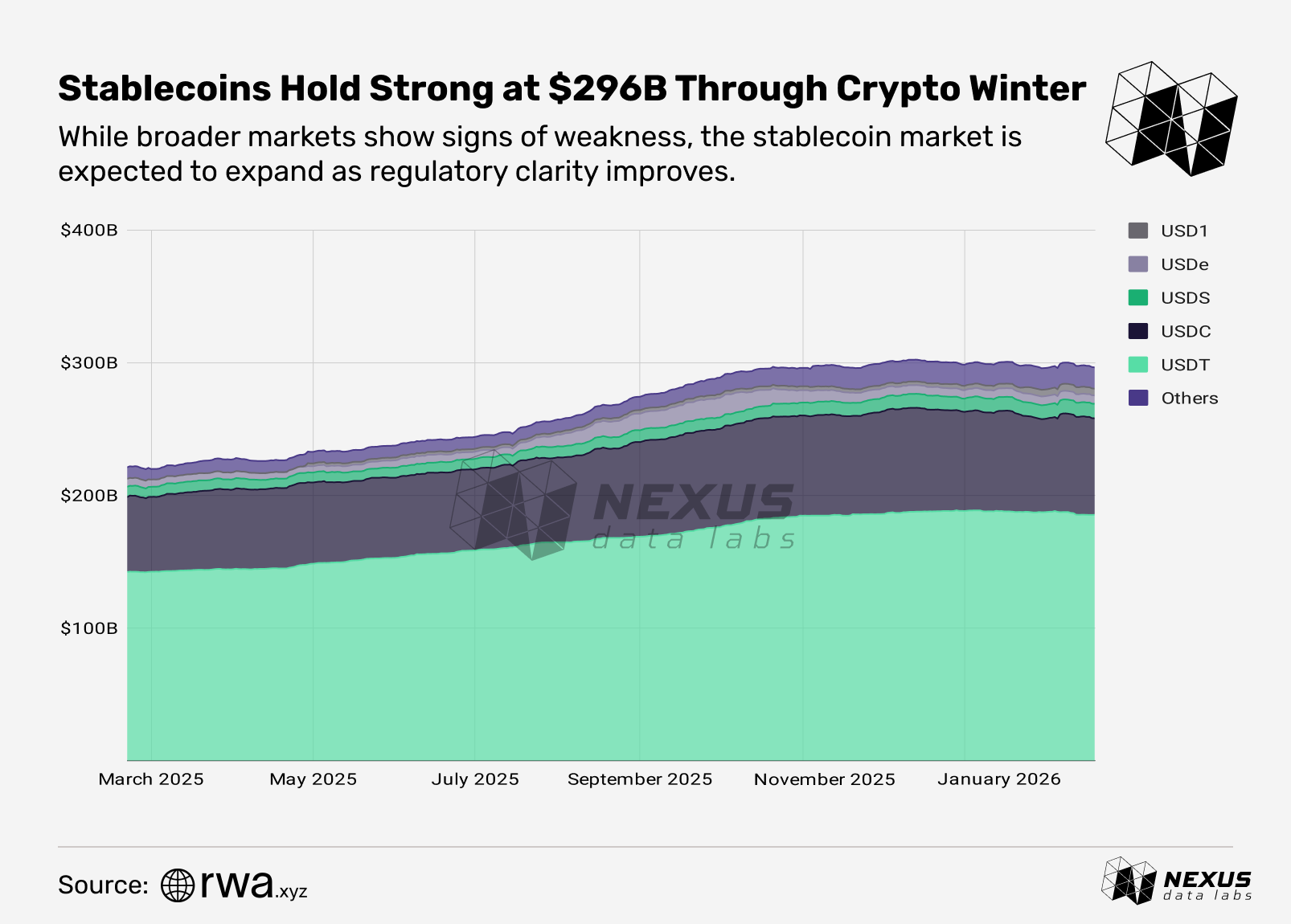
The Big 2 (USDT and USDC) hold 87% market share and drove 59% of year-over-year growth. Notable movers by market cap include World Liberty Financial’s USD1 (#5, +$5.1B), PayPal’s PYUSD (#6, +$3.3B), and Sky’s USDS (#3, +$3.1B), while Ethena’s USDe saw the sharpest rise and decline, falling 58% from its $14.9B ATH after the October 10 tariff-driven crash accelerated a flight from synthetic to fiat-backed stablecoins.
Despite the crypto winter, we expect stablecoin markets to continue growing as regulatory clarity for tokenized assets and institutional onchain adoption advance.
Non-USD Stablecoins
From 2023 to 2026, monthly transfer volume of tracked local currency stablecoins on EVM and Solana rose 18x from ~$600M to ~$11B, far outpacing market cap growth
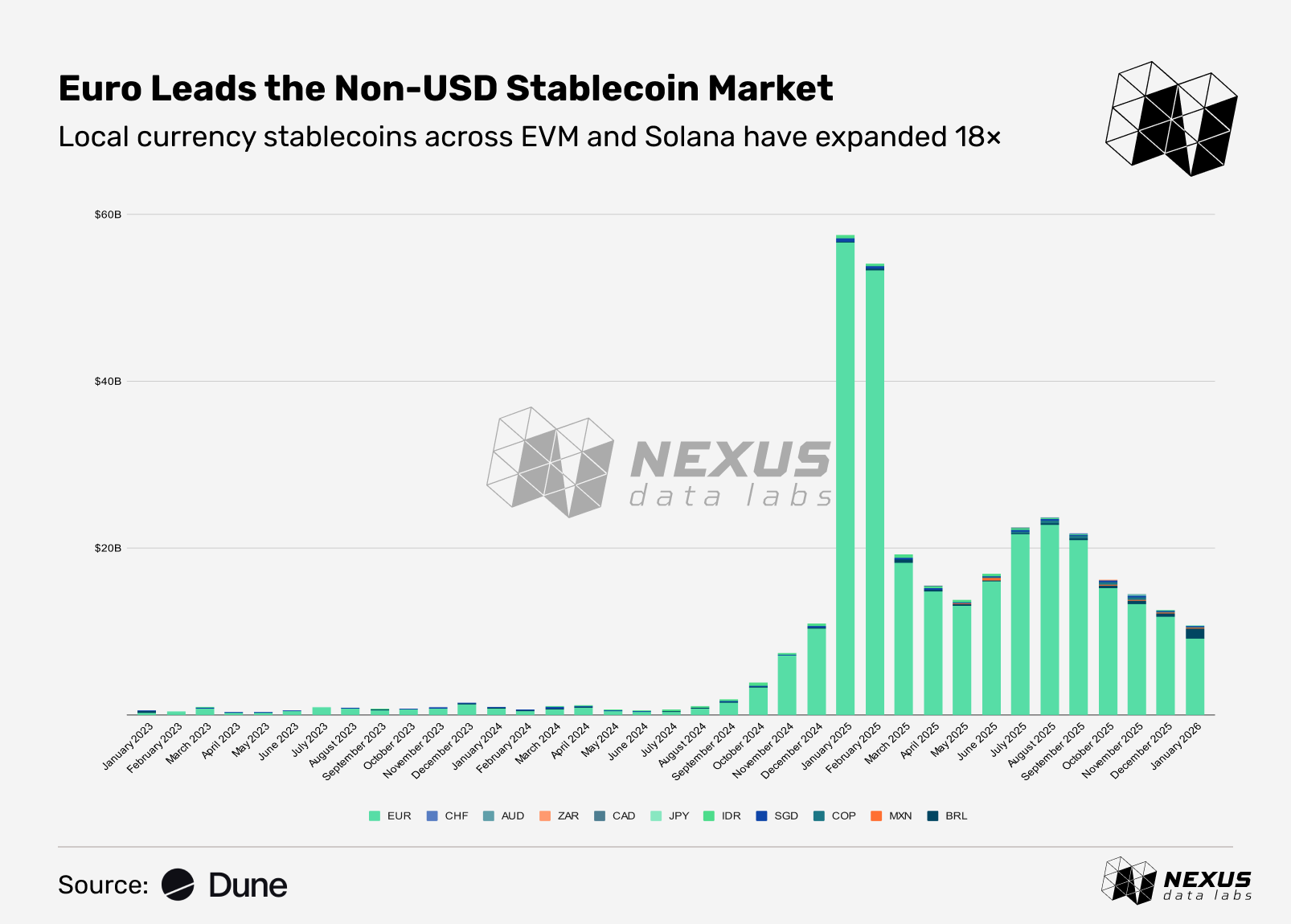
Local currency stablecoins are not merely accumulating balances; they are turning over more frequently in payments, FX, and treasury flows. Rising velocity alongside a 20x increase in monthly senders indicates structural adoption as settlement infrastructure. In short, usage is scaling faster than supply.
Hyperliquid’s $USDH
Analyst: Brandyn Hamilton | Website | Dashboard
USDH issuance demand has softened. Net weekly supply swung from a peak of +29.7 million on November 24 to flat or slightly negative over the past month
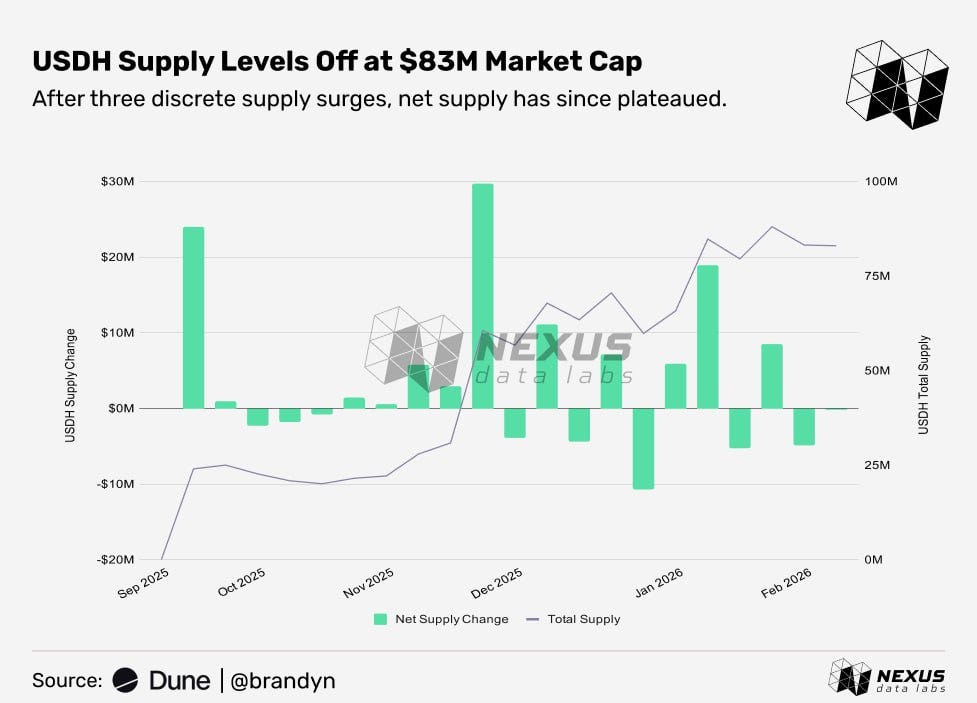
USDH is a USD stablecoin natively issued on the Hyperliquid network. Mints and burns occur on HyperEVM, the canonical deployment, and can be bridged to HyperCore, the ledger network used by the protocol. USDH serves as the quote asset for the Hyperliquid network. Supply has plateaued at roughly 83 million in mid-February.
The majority of the growth has been driven by spikes, with September 22, 2025 (+24M), November 24, 2025 (+29.7M), and January 12, 2026 (+19M) responsible for most gains. Each spike was smaller than the last, with the January 2026 spike 36% below the November 2025 spike. Over the past four weeks, net supply fell 1.8M, sitting 5.6% below the January 2026 ATH of 88M. Without new demand catalysts, the trend is contraction.
Closing Thoughts
Taken together, this week’s insights highlight three key dynamics:
Dollar-backed giants USDT and USDC still dominate market share and growth
Non-USD stablecoins are scaling in usage faster than supply, signaling real transactional demand
Protocol-native stablecoins face clear demand cycles, where sustainability depends on continued catalysts.
We are closely watching the institutional expansion to blockchains through stablecoins since this sector remains one of the cleanest signals of where real economic activity is happening onchain.
Next week, Nexus Data turns to Real World Assets, examining how tokenized RWAs are teasing a reshape of capital markets.
We’ll end with a few items we’re noticed in the stablecoins space. See you next week.
What we're watching
Latin America local stablecoins as a glimmering map

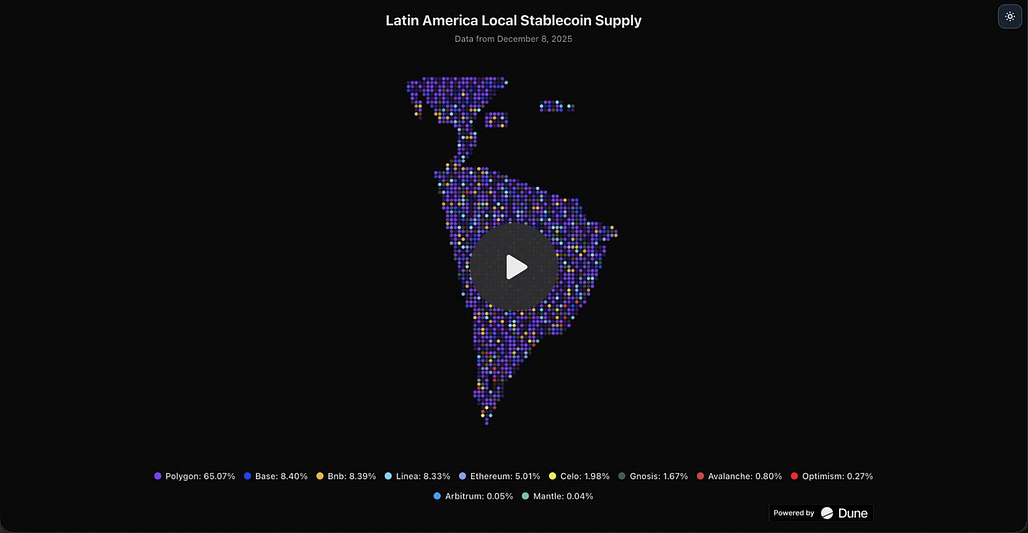
Dune has released their stablecoin datasets