


Intro
Welcome to the third edition of Nexus Data Labs. Our aim is to alert you to what really matters in the fast-developing world of onchain finance.
Thank you to Diego, and Owen, and J.W. for contributing to this issue.
Setting the Scene
Over the past two years, perpetual DEXs have evolved from a DeFi experiment into one of the most competitive frontiers in onchain trading — pulling derivatives trading that once belonged almost exclusively to centralized exchanges into a trustless, self-custodial environment.
As scaling solutions mature and liquidity deepens across L2s and high-performance chains, the performance gap between onchain venues and centralized exchanges, once thought to be out of reach, has narrowed dramatically.
Perpetual futures, derivatives with no expiry date that allow traders to go long or short with leverage, require no custody of the underlying asset and no rolling of contracts. What began as an attempt to replicate centralized markets onchain has since evolved into a diverse and highly competitive ecosystem.
This week’s edition highlights four platforms leading that next phase of perp DEXs: Hyperliquid’s HIP-3 Deployers, Lighter, Aster, and GRVT.
Perp DEXs Overview
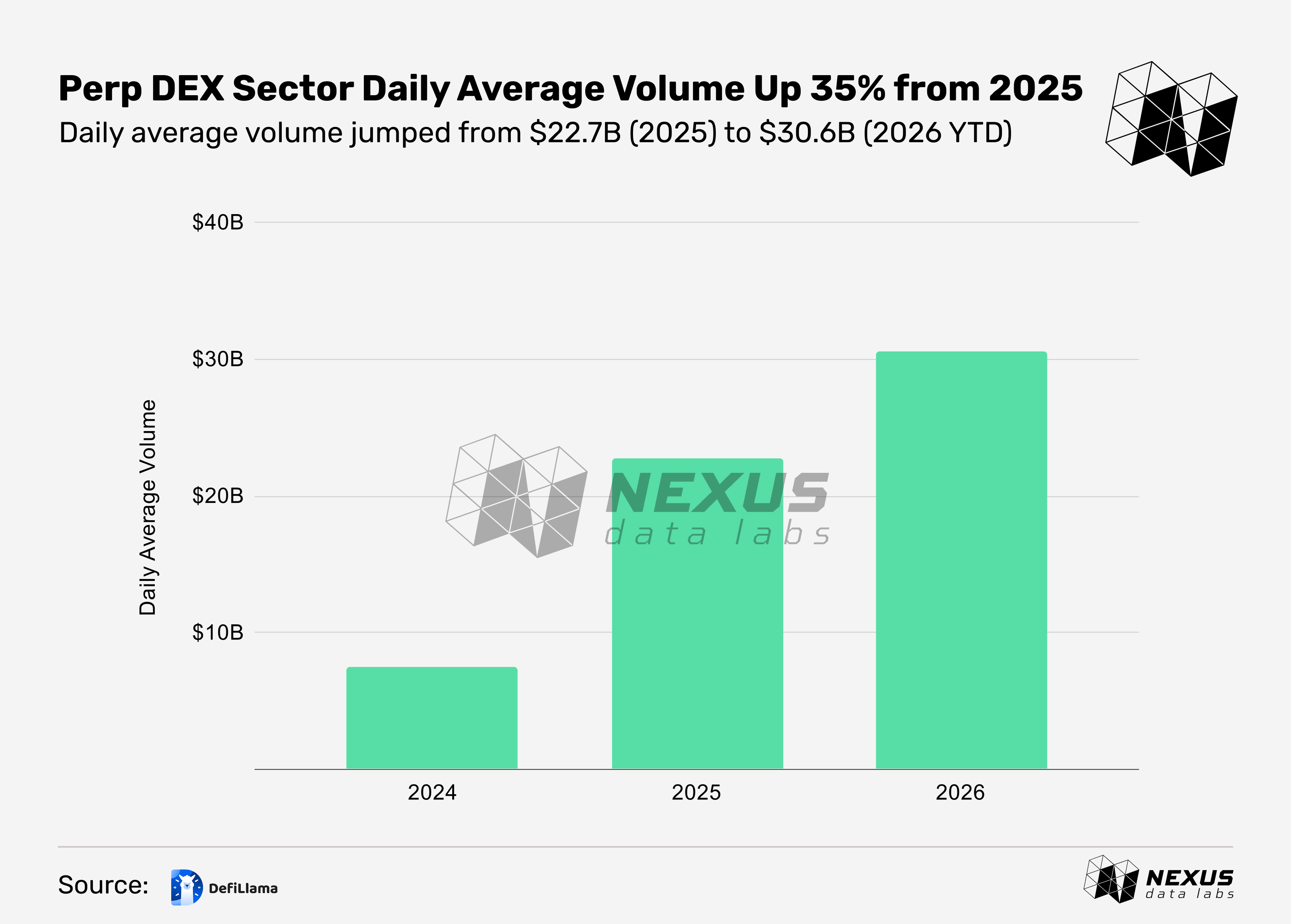
Perp DEX sector daily volume is up 35% from 2025, annualizing to $11.17T
Growth in the perp DEX sector is accelerating: daily average trading volume jumped from $7.5B (2024) to $22.7B (2025) and $30.6B (2026 YTD). That is a 35% increase from the previous year's average, which was approximately 3x higher than the year before.
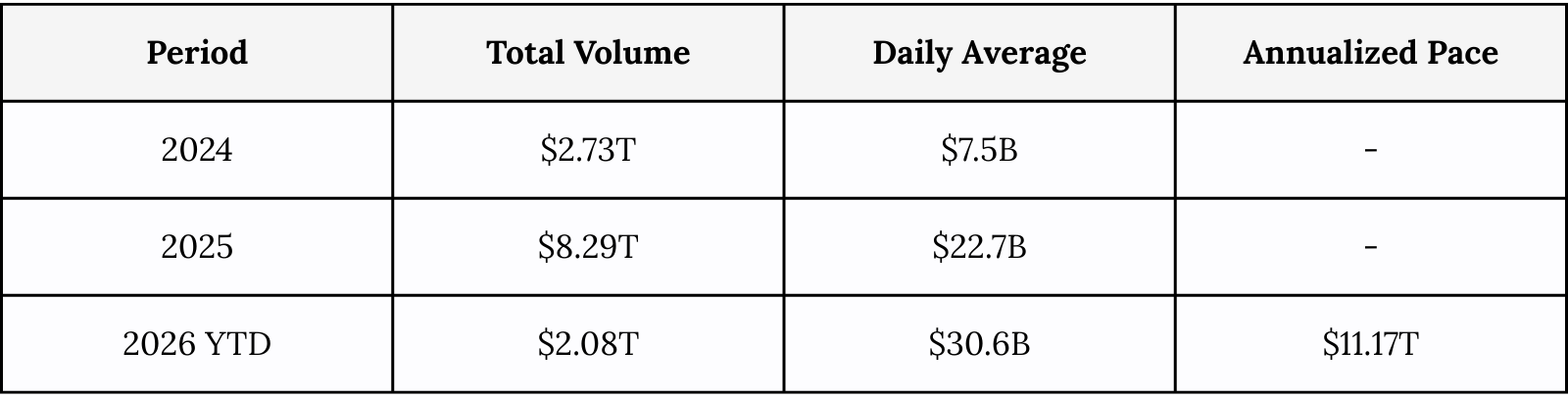
With $2.08T volume in just 69 days this year, the sector is on pace for $11.17T annually, representing a 34% increase from 2025's full-year total. Hyperliquid maintains sector dominance at 22.4% of volume, while Aster and Lighter account for roughly 31% combined.
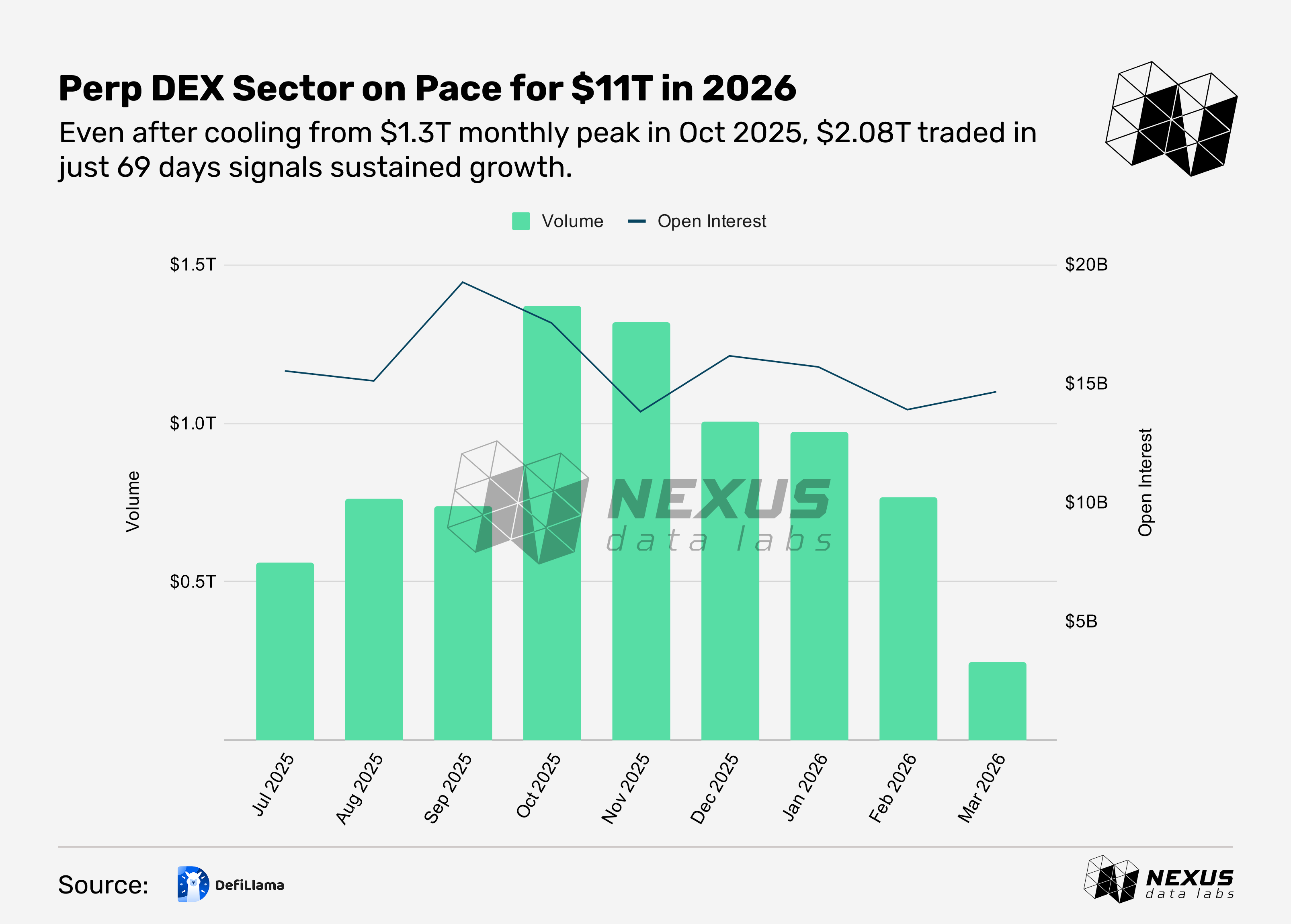
The numbers suggest 2025 was the adoption phase; 2026 is the growth phase, an era of higher capital efficiency, and intensifying institutional participation driving volume to record levels.
HIP-3 Perp DEX
HIP-3 tops $98B in cumulative volume amid weak market sentiment
Hyperliquid Improvement Proposal 3 (HIP-3) is a significant protocol upgrade enabling permissionless, decentralized creation of perpetual markets. Any user can now deploy a perp market by staking 1M $HYPE. This removes gatekeepers from market creation entirely.
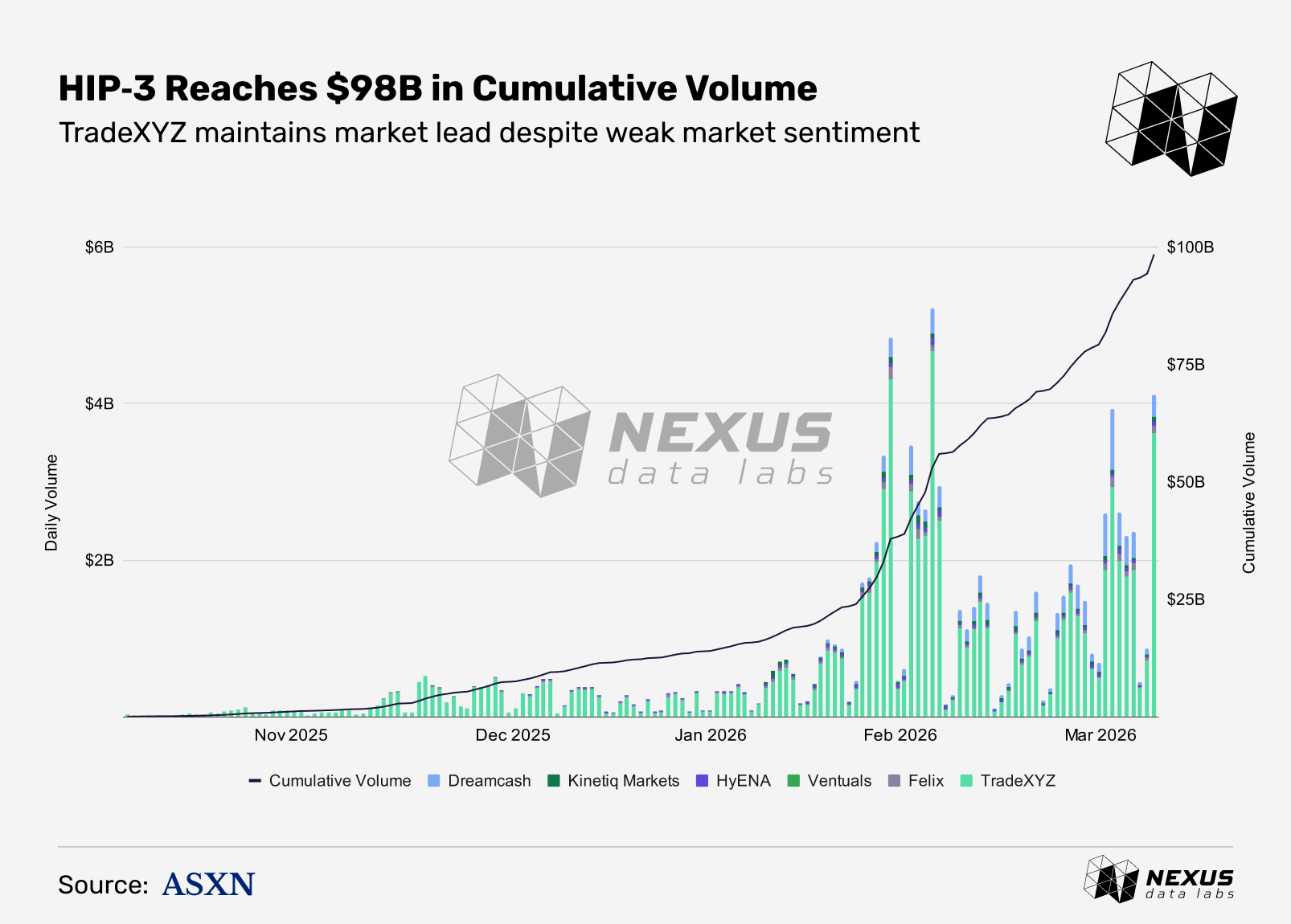
Since deployment, cumulative trading volume has surpassed $98B. TradeXYZ, a perp market deployer, has emerged as the dominant venue, capturing 83.9% of volume and 87.6% of open interest. Dreamcash and Felix round out the early competitive set. As of March 2026, total daily open interest holds above $1.2B — a signal that the upgrade is generating sustained activity, not just initial noise.
Perhaps the more consequential story is what HIP-3 enables beyond crypto-native assets. Builders are already deploying markets for TradFi instruments — Nvidia, Anthropic, and uranium among them — effectively using Hyperliquid as infrastructure to bring traditional asset classes onchain. If that trend continues, HIP-3 could represent something larger than a protocol upgrade: a meaningful step toward converging onchain and TradFi markets.
Lighter
Lighter’s TVL plummet by 54% post airdrop
Lighter is a perpetuals DEX built as a ZK-rollup on Ethereum. At its peak, daily perp volume surpassed $18.9B with TVL exceeding $1.4B. These metrics spiked sharply in Q4 2025 as anticipation around an airdrop built.
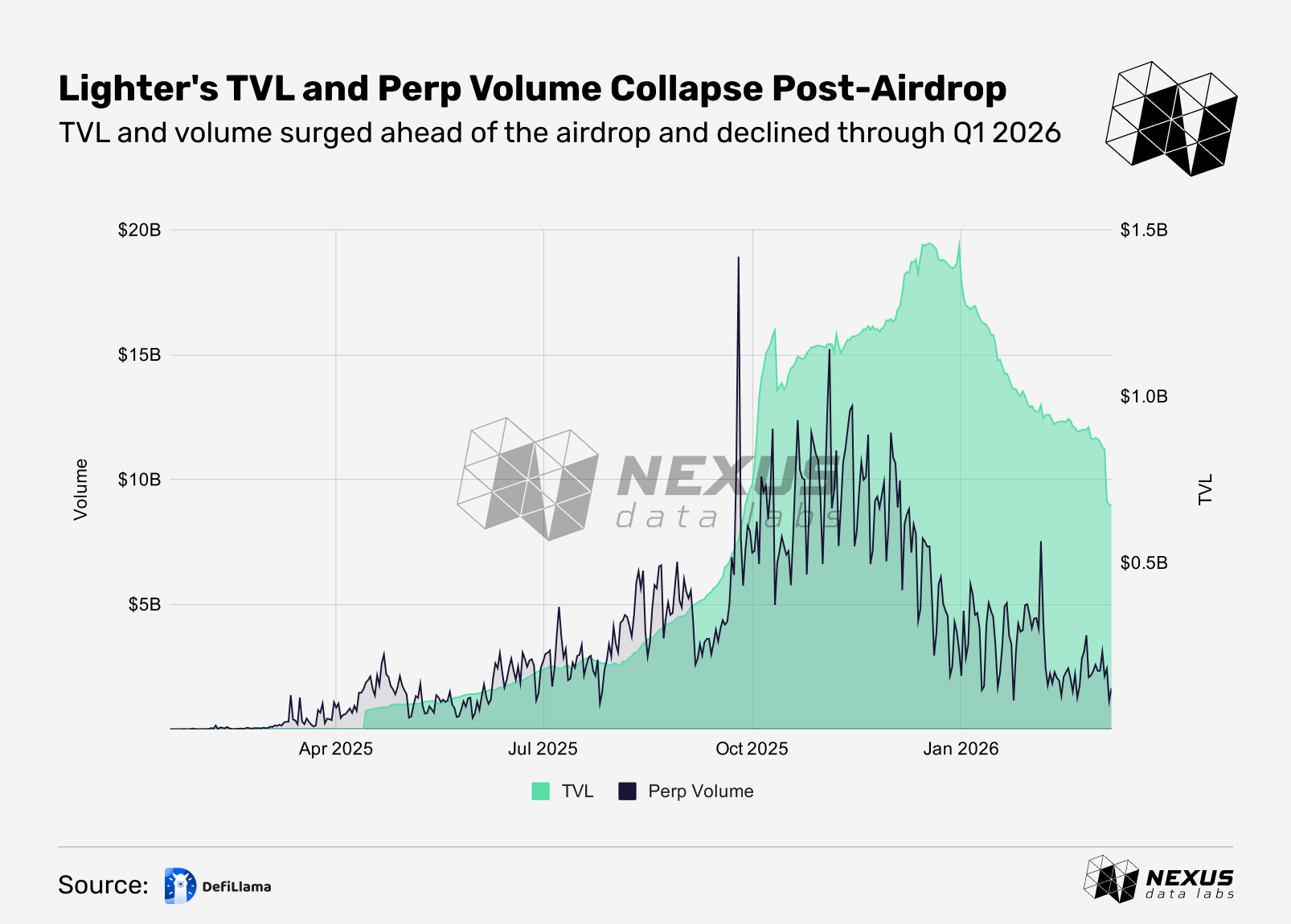
On Dec. 30, 2025, that speculation was confirmed: Lighter distributed 25% of its native token, $LIT, in one of the more closely watched token launches of the year. However, post-airdrop data has since answered the underlying question. As of March 2026, TVL has fallen to ~$600M and daily perp volume has retreated to the low single-digit billions, marking a significant drawdown from peak levels.
Aster
Owen Fernau | Website | Dashboard
Aster perp volume and token price both down over 60% from late 2025 highs
Aster is a perp DEX that consistently ranks in the top 5 by volume according to DefiLlama. As of March 2026, Aster ranks second among perp DEXs with $78.6B in volume over the past 30 days.
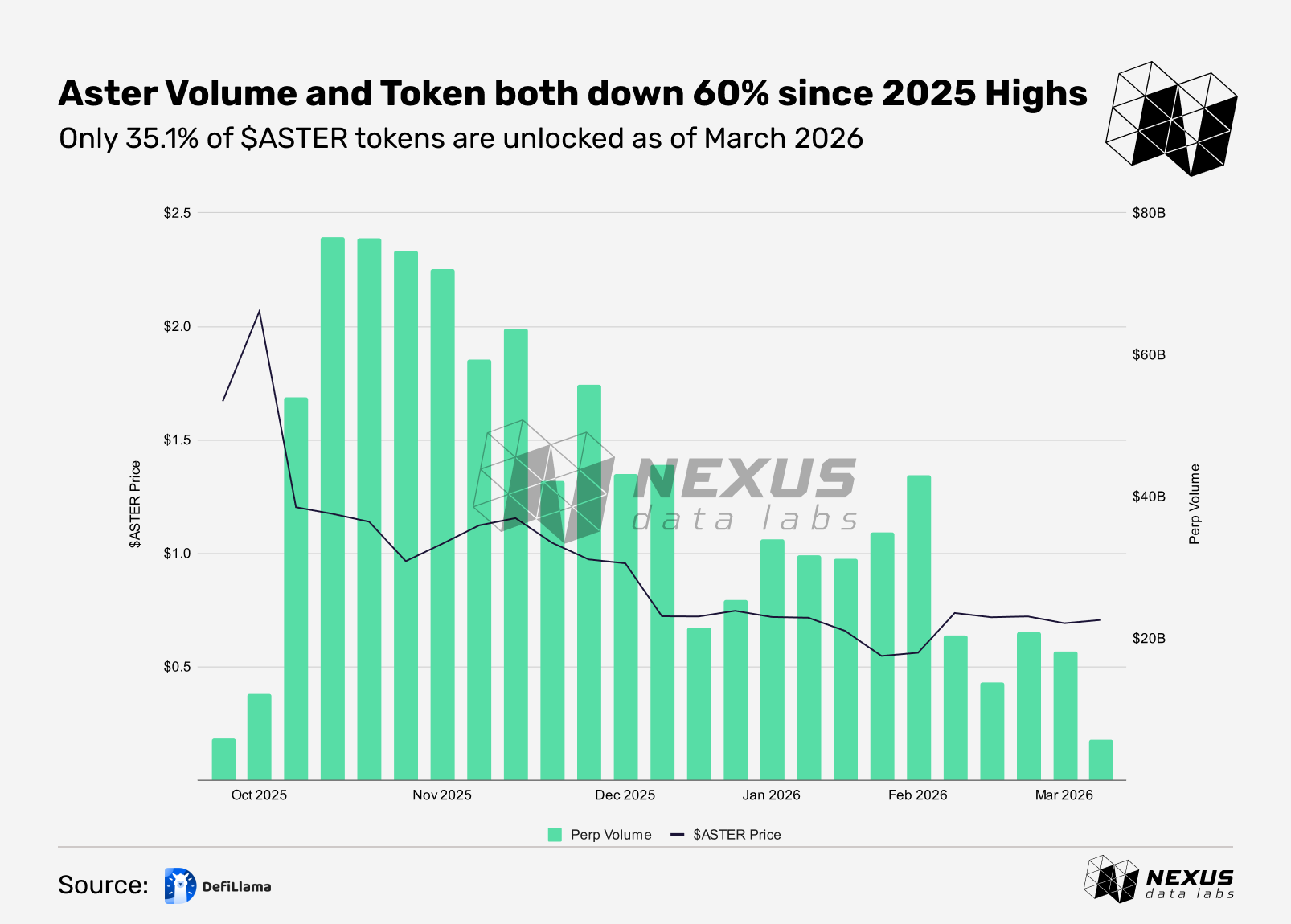
The $ASTER token is down 67% to $0.69 from its $2.07 October 2025 peak. At $18.1B, perp volume is down 76% from its mid-October weekly peak of $76.6B. Volume exploded when the $ASTER airdrop hit in late September 2025. It remains to be seen whether the token can sustain itself as incentives taper off.
Only 35.1% of $ASTER tokens are unlocked as of March 2026, meaning the market will eventually need to absorb the remaining 63.9% of the token supply to even maintain its price level of $0.70.
GRVT
Diego Cabral | Website | Dashboard
GRVT grows 340% year-over-year: weekly volume surges from $2.2B in 2025 to $9.7B in 2026
GRVT is experiencing fast growth in a competitive sector, with 2026 YTD weekly volume averaging $9.7B, a 377% increase from 2025's $2.19B weekly average. The protocol has accumulated $104B in 2026 YTD, annualizing to a $540B run rate versus $113.70B for full-year 2025 — signaling a potential 4.8x expansion trajectory.
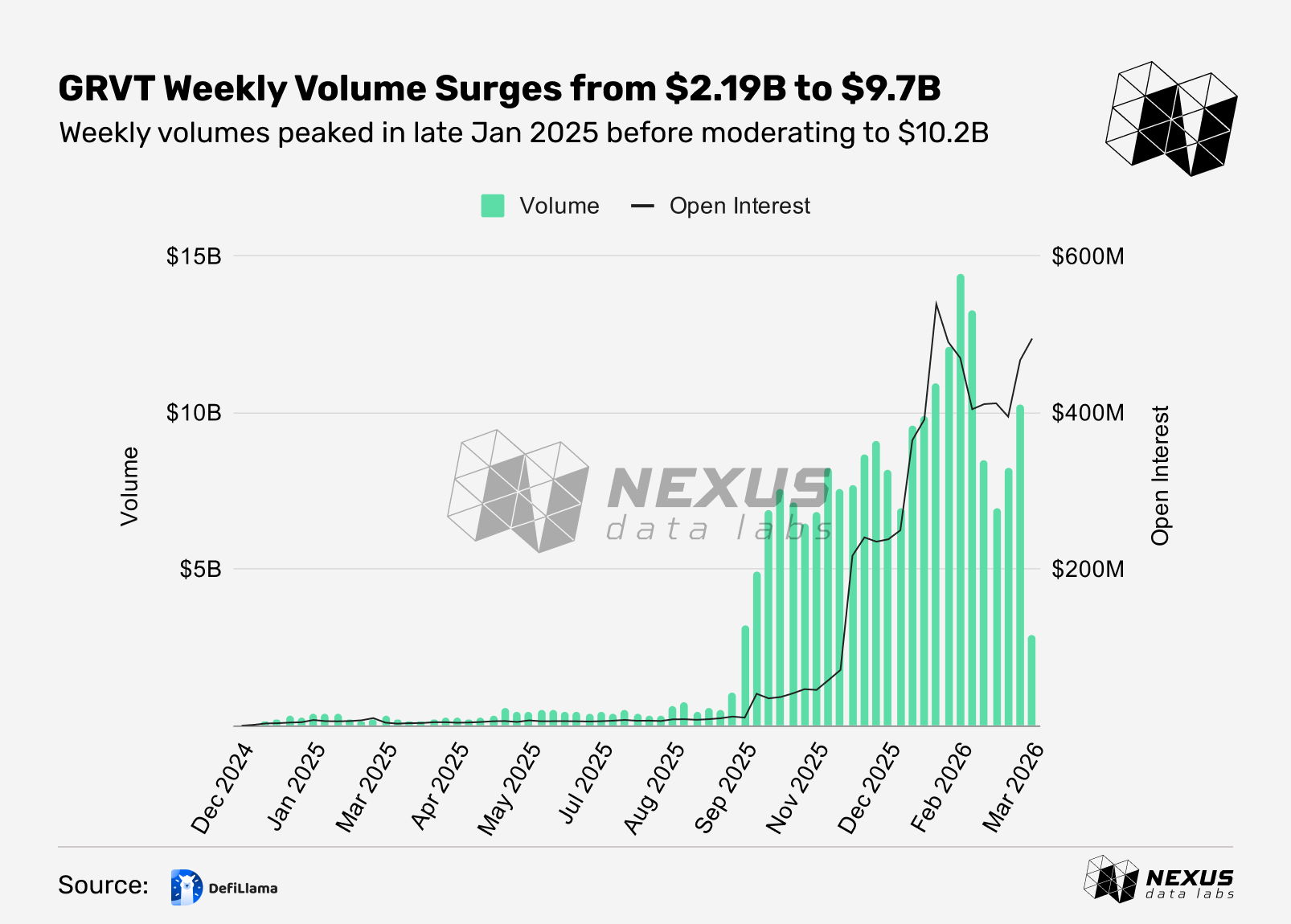
While still trading at 21% of Hyperliquid’s 2026 volume, GRVT has captured significant market share. Its $470M open interest reflects a growing user base. Weekly volumes peaked in late January 2026 at $14.47B before moderating to $10.27B in early March 2026, consistent with sector activity but at dramatically higher absolute levels than the previous year. GRVT's momentum suggests emerging product-market fit and/or user migration after Lighter’s airdrop.
Closing Thoughts
This week’s insights highlight that perpetual DEXs are clearly past the “experiment” phase. Sector-wide volumes are compounding, new architectures like HIP-3 are onboarding non-crypto assets, and challengers such as Lighter, Aster, and GRVT have shown they can briefly rival incumbents.
However, the data also makes one point clear: initial spikes driven by incentives and airdrops are not enough. What ultimately matters is how much volume, open interest, and liquidity remain once the rewards fade.
The protocols that maintain depth and activity after incentives fade — through better execution, differentiated markets, and credible paths to real economic use — are the ones most likely to shape the next generation of onchain derivatives infrastructure.
What We're Watching
Next Week
Next week, we turn to prediction markets, to analyze the growth and usage of one of the hottest sectors of the onchain economy.