


Welcome to the fourth edition of Nexus Data Labs. Our aim is to highlight what matters most in the fast-developing world of onchain finance.
Thank you to Filippo, Peter, J.W., and Diego for contributing to this issue.
Setting the Scene
Prediction markets entered the spotlight during the 2024 U.S. Presidential election. What had been considered a niche corner of the onchain economy became part of the mainstream conversation overnight. The question that followed was simple: would prediction markets survive once the election hype faded?
The 2025 data delivered a resounding answer: yes. Starting in September 2025, the sector began posting volumes that matched and then exceeded previous cycle highs. October 2025 marked a new all-time high for notional volume, followed by consecutive monthly records through January 2026. That growth has since drawn a new wave of prediction markets into the space.
It is worth noting that while Polymarket and Kalshi currently dominate the space by volume, Nexus focuses exclusively on blockchain-based activity. Coverage is scoped to Kalshi's onchain activity and its partnership with DFlow, which provides tokenization infra for prediction markets.
Overview
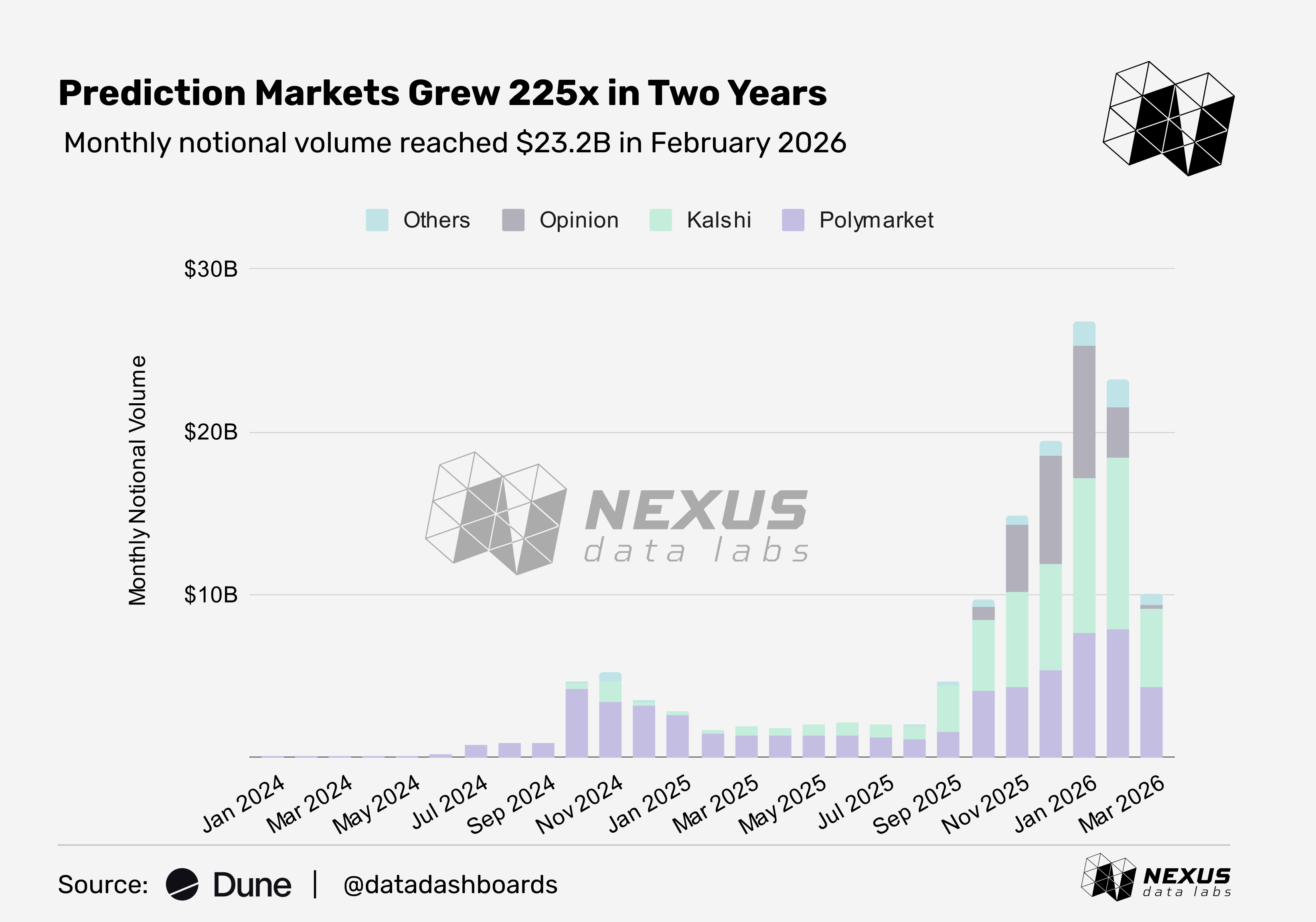
Prediction markets grew 225x in two years — Sports now lead
The prediction market sector grew 225x in two years, from $103M to $23.2B in monthly volume.
Polymarket rebounded after the 2024 election to reach $7.9B in monthly volume in February 2026 —nearly twice its prior peak— but lost share as rivals scaled faster. Kalshi climbed from $1.2B to $10.4B in monthly volume, rising from under 3% share to 45%, while Opinion reached 30% share within months.
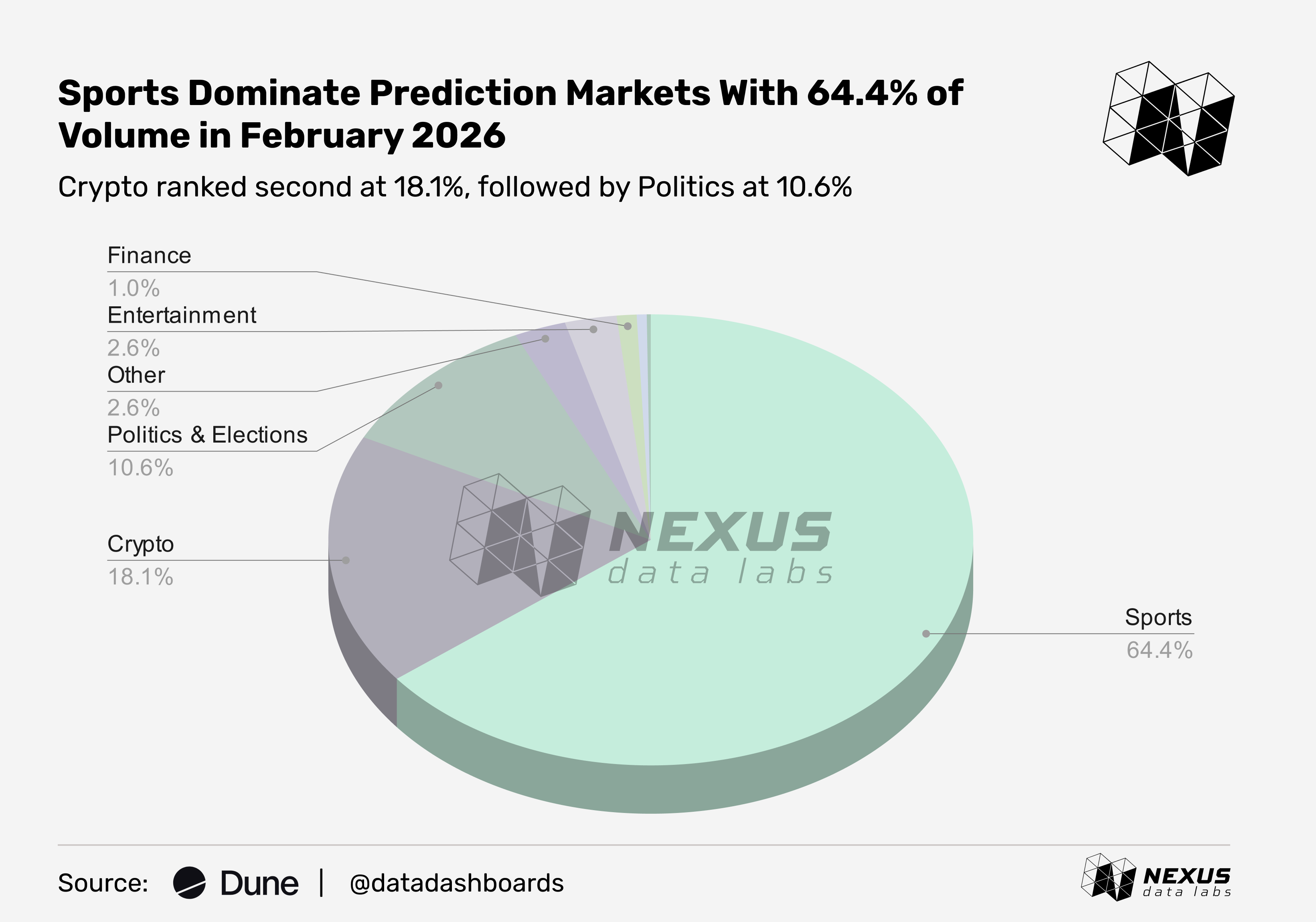
Across Polymarket and Kalshi, sports led category share at 64.4%, followed by crypto at 18.1% and politics at 10.6% as of February 2026. This is largely driven by Kalshi's aggressive expansion into sports event contracts. Polymarket's mix is more balanced across crypto, politics, and entertainment.
Polymarket
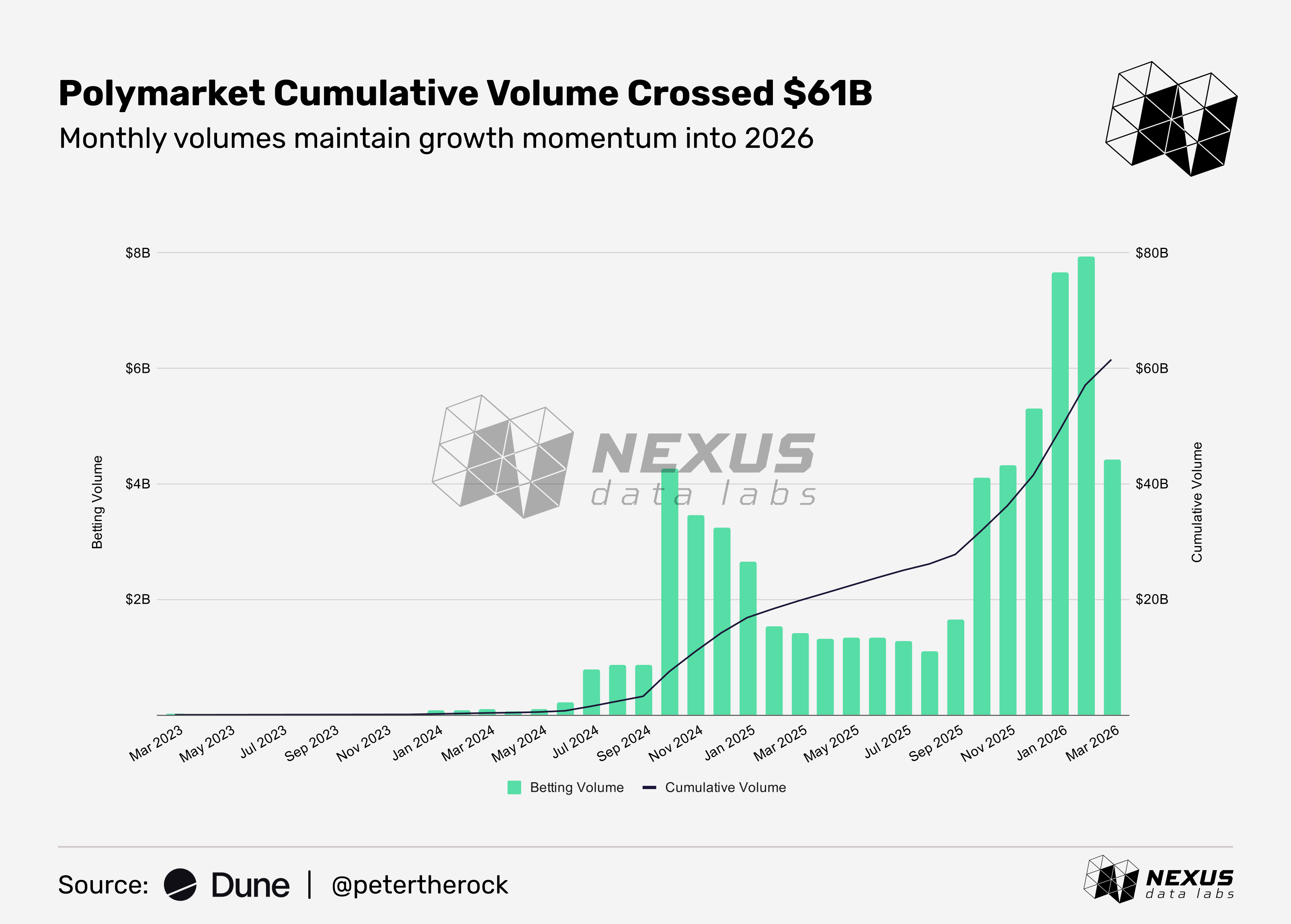
Polymarket posts $7.94B in February 2026 volume as bet activity surges 55% month-over-month
Polymarket continues to see accelerating growth across trading activity and trader capital. The platform has generated over $61B in cumulative trading volume. In February 2026, $7.94B was traded, up 3.7% from January's $7.66B. Participation is also rising, with 80.7M bets placed in February, up 55% from 52M in January.
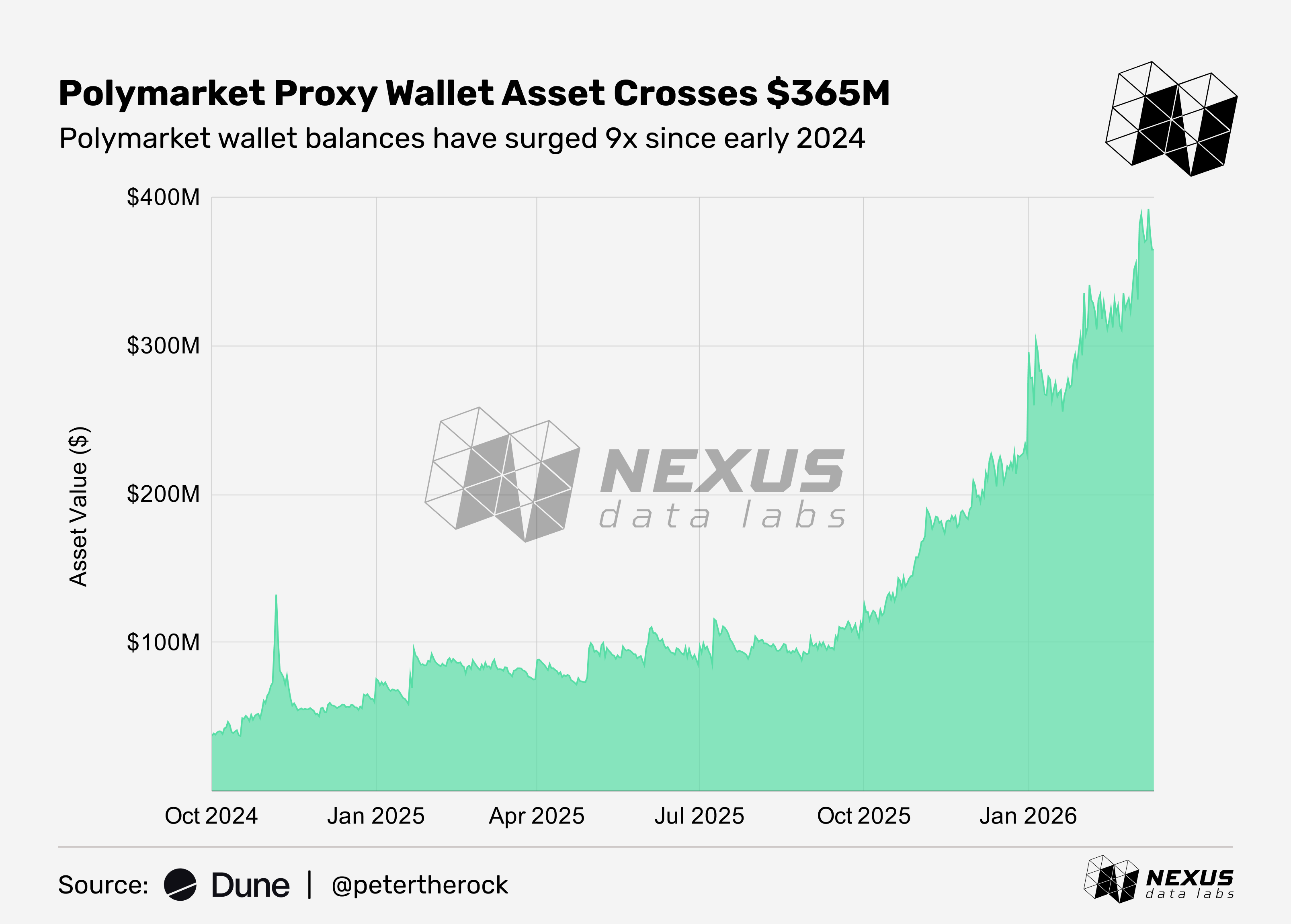
Trader capital has expanded alongside activity. As of February 2026, approximately $336M is held across Polymarket proxy wallets, up from $37M in October 2024, representing over 9x growth in 16 months.
Taken together, rising volumes, bet activity, and trader capital highlight the maturation of onchain prediction markets.
Polymarket vs. Polygon
Polymarket is Polygon's biggest tenant, consuming 77% of its blockspace
Polymarket isn't just the dominant prediction market. It is now the dominant application on Polygon itself. In March 2026, the platform consumed 77% of all compute units on the network, generated 67.6% of gas fees, and accounted for 54.4% of total transactions. By any infrastructure measure, one application has effectively become the chain's anchor tenant.
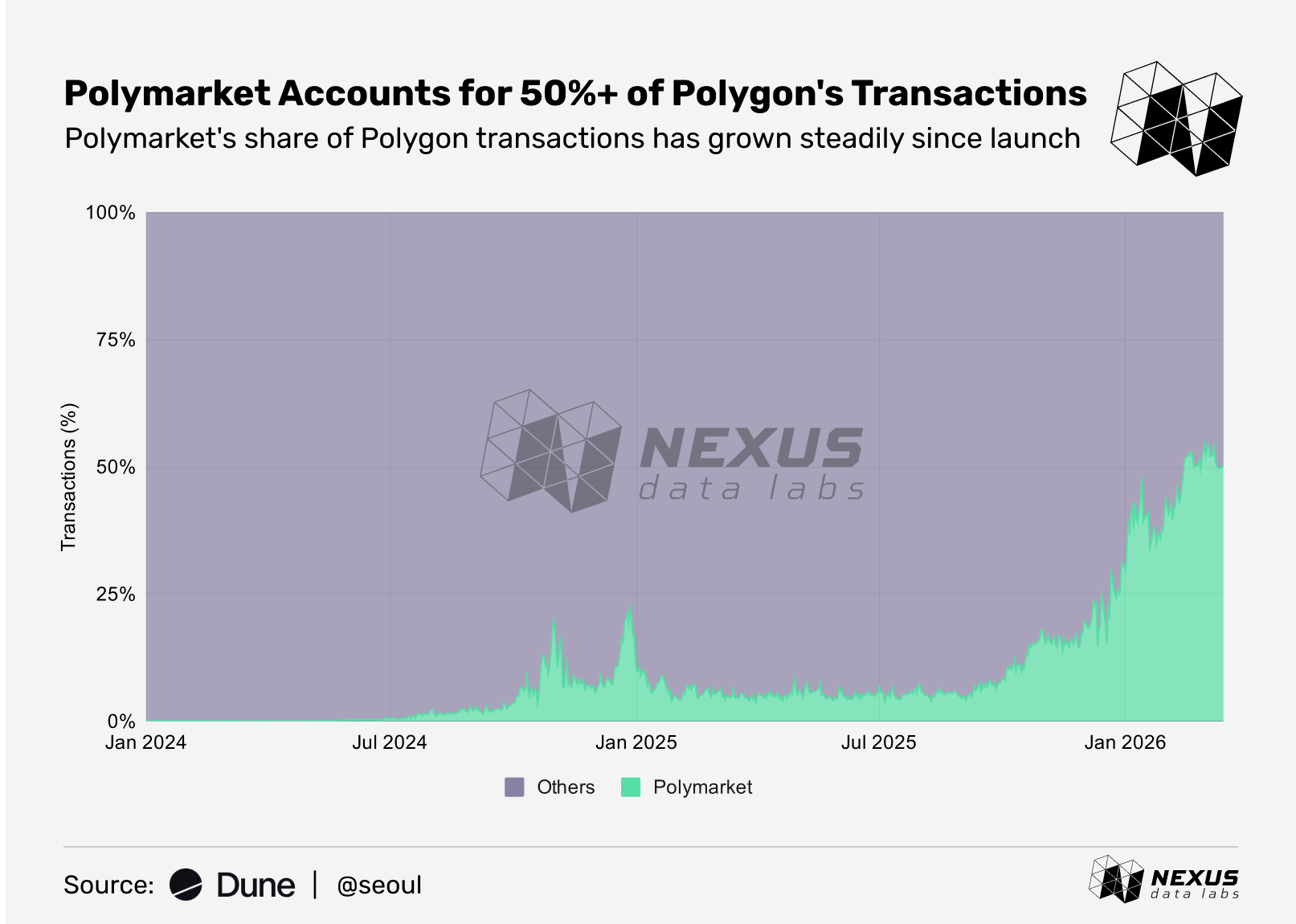
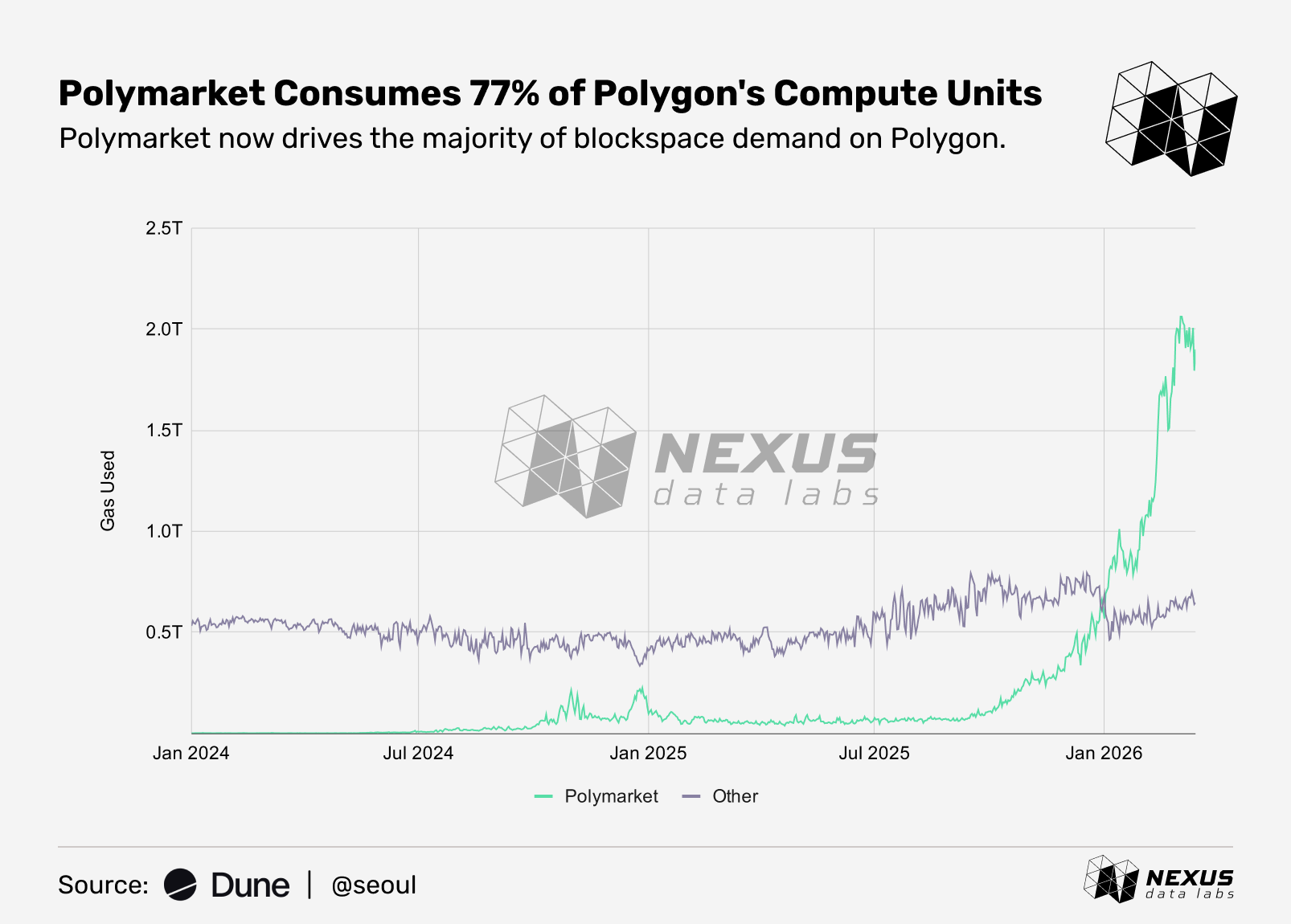
While network usage exceeds 50% of Polygon, Polymarket traders represent only 19.7% of daily active users on Polygon. That asymmetry raises a question worth examining: is this healthy concentration or structural dependency? The bull case is straightforward: Polymarket is a world-class application generating sustained, organic demand for Polygon blockspace. The bear case is equally clear. A single application generating the majority of network gas means Polygon's throughput economics are effectively tied to one protocol's growth trajectory. If Polymarket migrates, scales to its own chain, or slows down, the network metrics will follow.
For now, the numbers reflect a symbiotic relationship that has worked. Polygon provides the settlement layer; Polymarket provides the demand. Whether that concentration becomes a liability depends on what Polygon builds next.
Kalshi Onchain Activity
Kalshi's onchain weekly volume peaks at $10M - Under 0.3% of total activity
While Kalshi has been experimenting with integrations across major Solana distribution channels, including DFlow, Phantom, and Jupiter, to make its markets accessible onchain, the strategy has yet to generate meaningful volume.
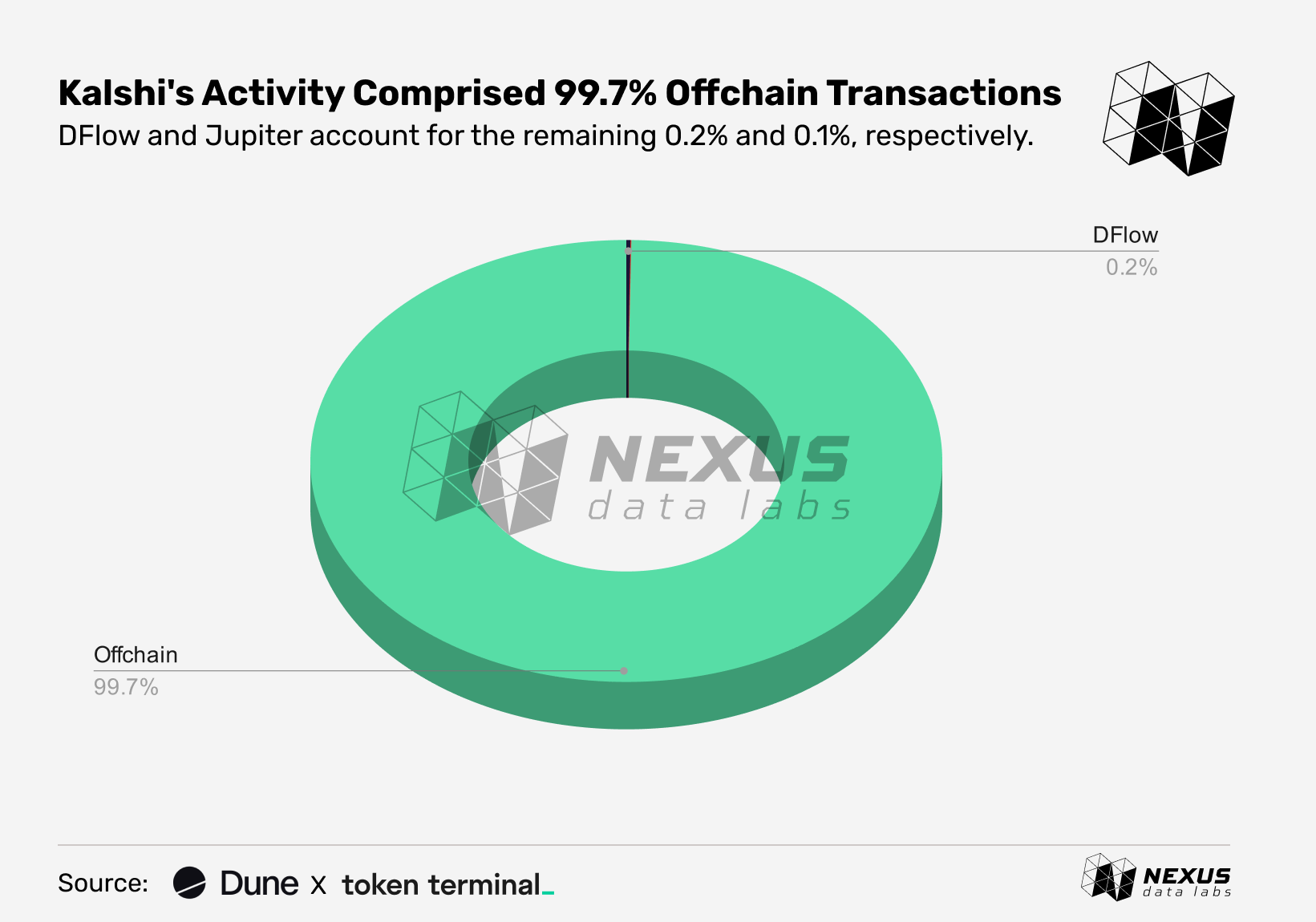
At its highest point, onchain notional weekly volume reached roughly $10M. To put that in context, Kalshi processed $1.9B in total notional volume during the week of Jan. 1 2026, making the onchain $10M peak just 0.53% of total activity. By the week of Feb. 1 2026, total weekly volume had risen to $2.19B, pushing that same $10M peak down to 0.46%. Onchain flow remains well under 1% of Kalshi's total trading volume, suggesting that the current distribution strategy has yet to materially expand market access or user interest.
Closing Thoughts
Prediction markets have proven they can grow beyond election cycles. Sports and politics have always been the two headline themes, and 2026 brings one of the largest global sporting events, the FIFA World Cup, which is likely to drive a fresh wave of users to the sector.
High-profile events have historically served as a natural entry point for new participants, many of whom go on to explore other categories. Whether those users remain active beyond event-driven speculation, however, remains the sector's defining open question.
On the regulatory front, clarity may also play an increasingly important role. Early steps toward clearer frameworks, such as the recent CFTC proposal, could reduce uncertainty and broaden institutional participation, creating a more stable foundation for long-term adoption.
What We're Watching
Next Week
Next week, we turn to the intersection between AI and the onchain economy, covering x402, the TAO ecosystem and how different data provider are approaching the use of AI for data analysis.