


Welcome to the sixth edition of Nexus Data Labs, where we highlight what matters most in the fast-developing world of onchain finance.
Thank you to J.W., Owen, and Diego for contributing to this issue.
Setting the Scene
The last edition opened the door on AI x blockchain infrastructure. This week we go deeper on two of the most active developments in that space: x402, an emerging payment framework enabling AI agents to transact autonomously onchain; and Bittensor, a decentralized network turning artificial intelligence into an open market. One is building the payment rails while the other is building the marketplace where AI models compete to produce intelligence. Both are early and moving fast.
x402
Owen Fernau & J.W. | Website | Dashboard
Approximately 38% of x402 cumulative transactions appear inorganic
x402 is a payment protocol built for the internet’s next layer: machine-to-machine transactions. The name comes from HTTP status code 402, “Payment Required”, a code that has existed in web standards since 1991 but was never formally implemented. x402 activates it. The core idea is simple. Rather than a human logging in, entering card details, or approving a transaction, x402 allows AI agents and software programs to pay for data, APIs, and services autonomously. For developers building AI agents that need to consume external data or services, x402 offers a standardized way to handle payments onchain without custom billing integrations.
Since launching in May 2025, x402 has processed over 166M cumulative transactions across $47M in total volume. But not all of that activity reflects genuine economic demand.
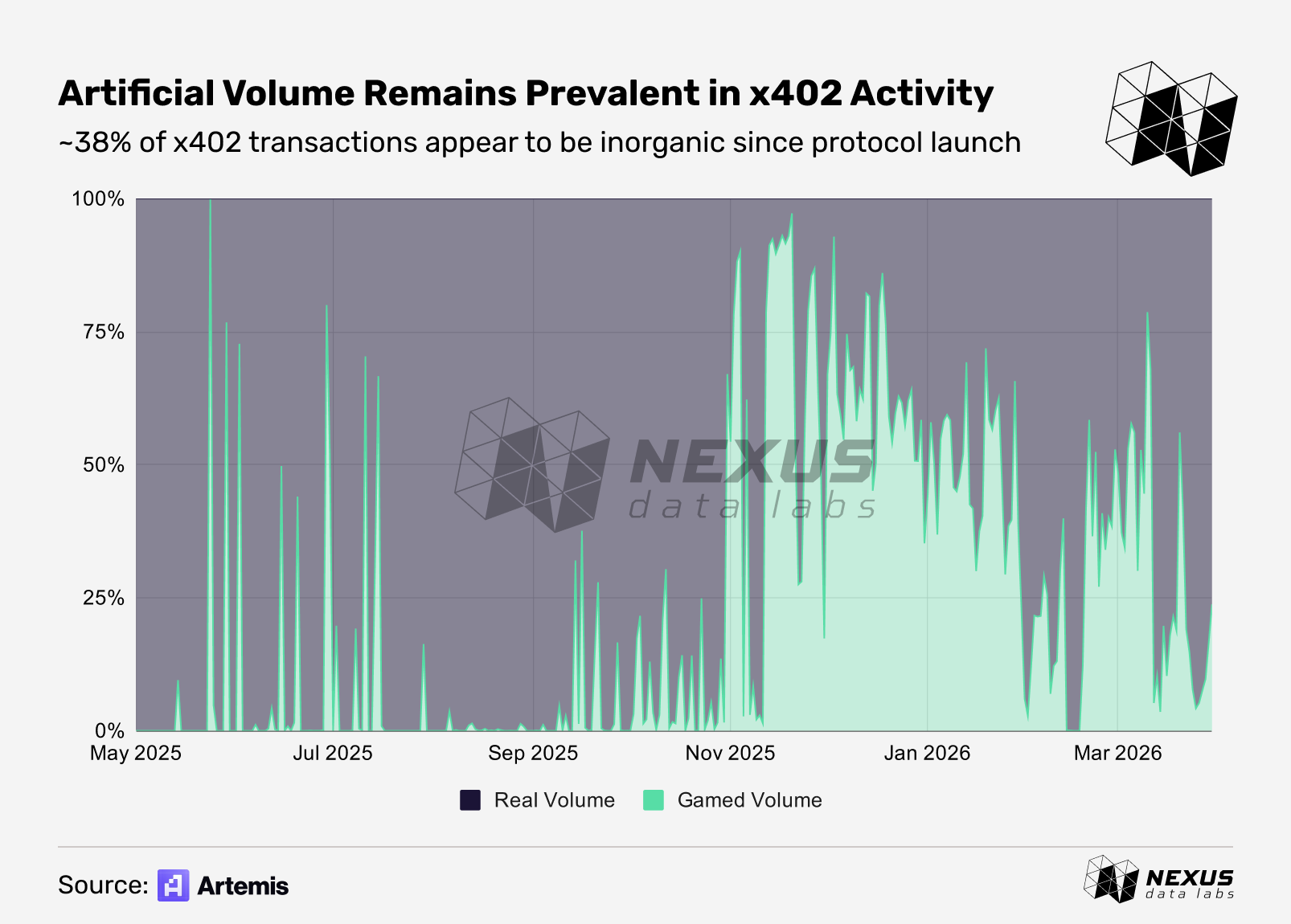
Artemis identifies two forms of artificial activity on x402: self-dealing, where the same wallet acts as both buyer and seller; and wash trading, where a seller wallet funds a buyer wallet that immediately returns the funds. Together, these two patterns account for approximately 38% of cumulative transactions.
The infrastructure is being built. Developers are integrating x402 into agent frameworks, standardizing payment flows, and shipping tooling. What has not yet materialized is sustained organic usage at scale. The protocol has a foundation. The next phase depends on whether genuine commercial demand grows into it.
Bittensor ($TAO)
$TAO rallied 88% in March 2026 as Covenant-72B validated decentralized AI training at scale
Bittensor is a decentralized network designed to transform artificial intelligence into an open market. Rather than concentrating AI development within a handful of large organizations, it enables anyone to build, contribute, and earn from machine intelligence at a global scale.
The network is organized around subnets, each an independent AI marketplace dedicated to a specific task. A subnet can focus on anything from large-scale model training and decentralized inference to GPU compute and financial prediction. Within each subnet, two classes of participants interact:
Miners supply the intelligence. They run models, process data, and produce outputs.
Validators measure quality. They assess each miner's contribution and determine who performed best.
Every day, a fixed pool of $TAO is distributed across the network. Subnets compete for their share by producing verifiable AI work. Those delivering the strongest results attract the most participants and capture the largest share of daily emissions.
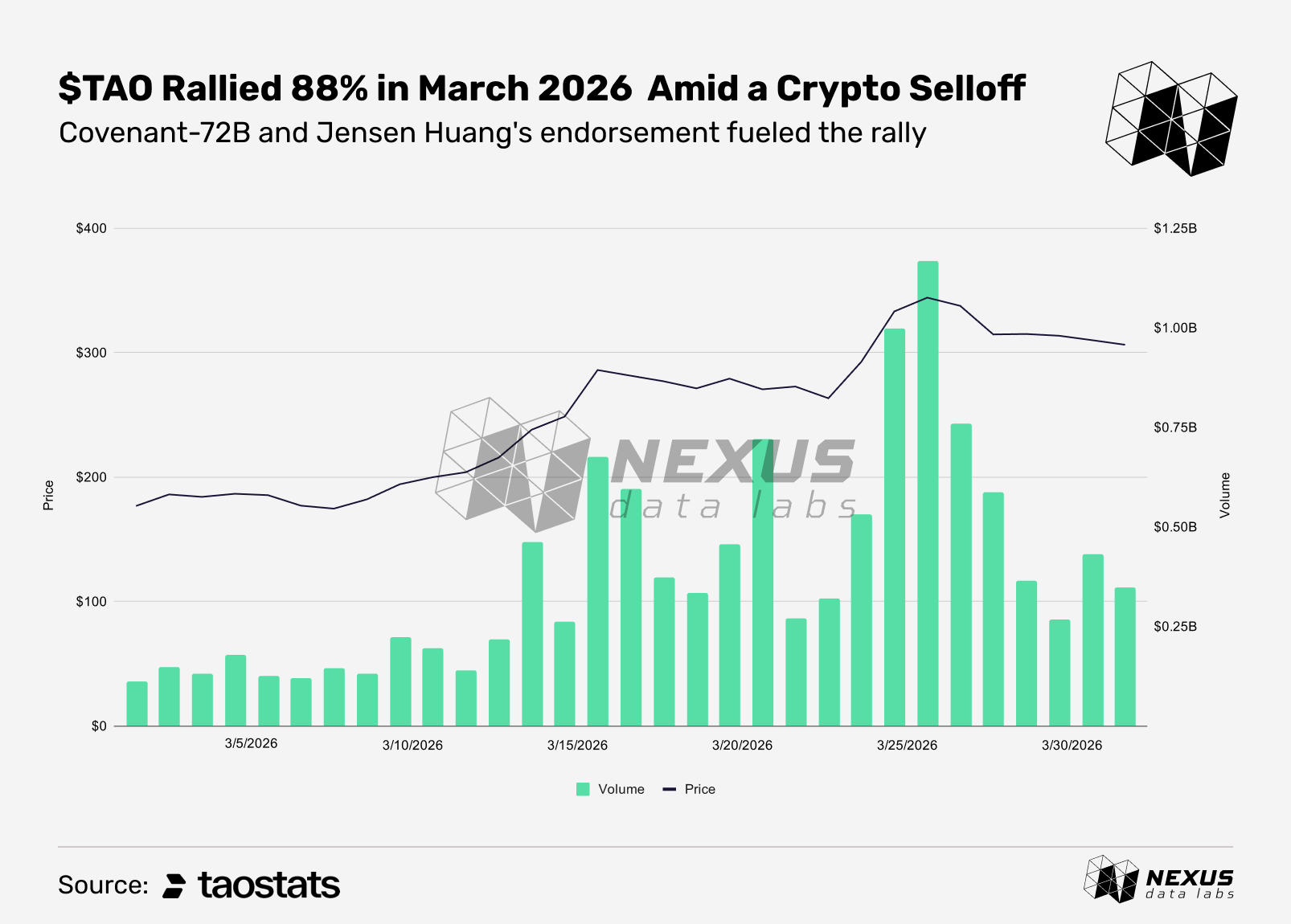
In March 2026, $TAO moved from $177 to $333, an 88% gain that outpaced a broader market deep in the red. Subnet market cap climbed to $1.38B over the same period, with individual tokens ranging from $1M to $126M and several subnet tokens posting 200–400% monthly gains.
Two catalysts drove the move:
Covenant-72B: Subnet 3 (Templar) completed the largest decentralized AI model training run across more than 70 contributors worldwide using ordinary consumer hardware. The model performed on par with one of Meta's most capable open-source models, Llama 2 70B. Before Covenant-72B, decentralized AI training at this scale was theoretical, but the model made it real.
Jensen Huang: On Mar 20, 2026, Nvidia CEO Jensen Huang endorsed Bittensor’s decentralized training model on the All-In Podcast, framing it as complementary to proprietary AI development. Coming from one of the most influential voices in AI infrastructure, the endorsement carried weight far beyond the usual crypto audience.
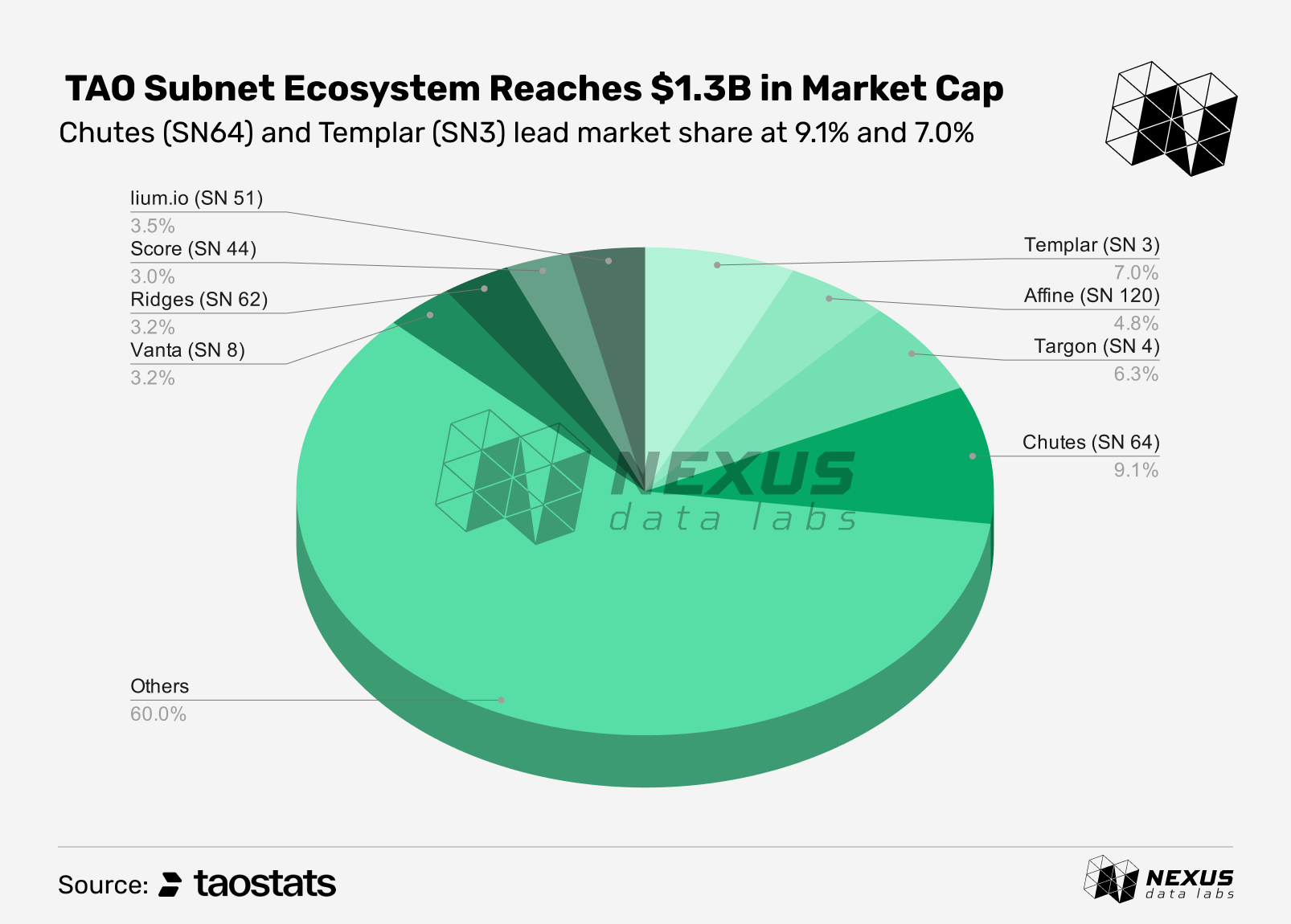
AI narratives are moving fast, and $TAO is riding that wave. The real test is whether subnets can sustain organic demand. Bittensor is among the most serious decentralized AI infrastructure experiments running today. Whether that translates into durable product market fit remains an open question, but the network is no longer just making promises.
Closing Thoughts
Bittensor and x402 represent two distinct but converging bets on where AI infrastructure is heading. Bittensor treats intelligence itself as a commodity, routing capital toward the subnets producing the most verifiable AI work. x402 removes the human from the payment loop entirely, letting agents pay for data and services autonomously. Together they sketch an early picture of what AI-native infrastructure looks like in practice.
Both protocols remain in a phase where narrative still runs ahead of usage data. Bittensor's subnet economy runs on daily emissions. x402's transaction base is roughly 38% inorganic. The infrastructure is being built and the direction is clear. What's still missing is real, sustained demand.
The protocols that close that gap will define which parts of the AI x blockchain stack actually matter. Everything else is infrastructure waiting for a use case.
What We’re Watching
Web3 Data Jobs
Nexus is partnering with Unchain Data to highlight opportunities across the onchain data ecosystem. This week’s featured openings: