



Intro
Welcome to the eighth edition of Nexus Data Labs. We are here to tell stories about onchain data. Our aim is to alert you to what really matters in the fast-developing world of onchain finance.
Thank you to Borja and Tom for contributing to this issue.
Setting the Scene
Yield-bearing tokens have drawn increasing attention across DeFi. As onchain treasuries and DAOs grow, so does the need to deploy idle capital productively. Holding stablecoins without yield is an opportunity cost that protocol treasuries can no longer justify at scale.
But yield alone is not enough. The source of that yield matters. A token backed by short-term US Treasuries carries a fundamentally different risk profile than one backed by perpetual futures funding rates or private credit. The convergence between TradFi yield sources and onchain distribution is no longer theoretical. It is happening at scale, with money market funds, government securities, and institutional lending all serving as backing for tokens that sit natively in DeFi.
The question is no longer whether yield should be tokenized, but which structures generate it, where the risk actually sits, and who captures the return.
This week, we break down three yield-bearing tokens: USYC, sUSDe, and BUIDL. Each takes a distinct approach to generating yield onchain.
USYC by Circle
Borja Neira | Website | Dashboard
USYC surges to $2.9B with 96% of supply concentrated on BNB Chain
USYC is a tokenized money market fund issued by Hashnote, a Circle subsidiary, backed by short-term US Treasury bills and reverse repo agreements. As of April 2026, USYC reached $2.90B in AUM, up 460% YoY and 91% YTD, overtaking BUIDL to become the largest tokenized Treasury product.
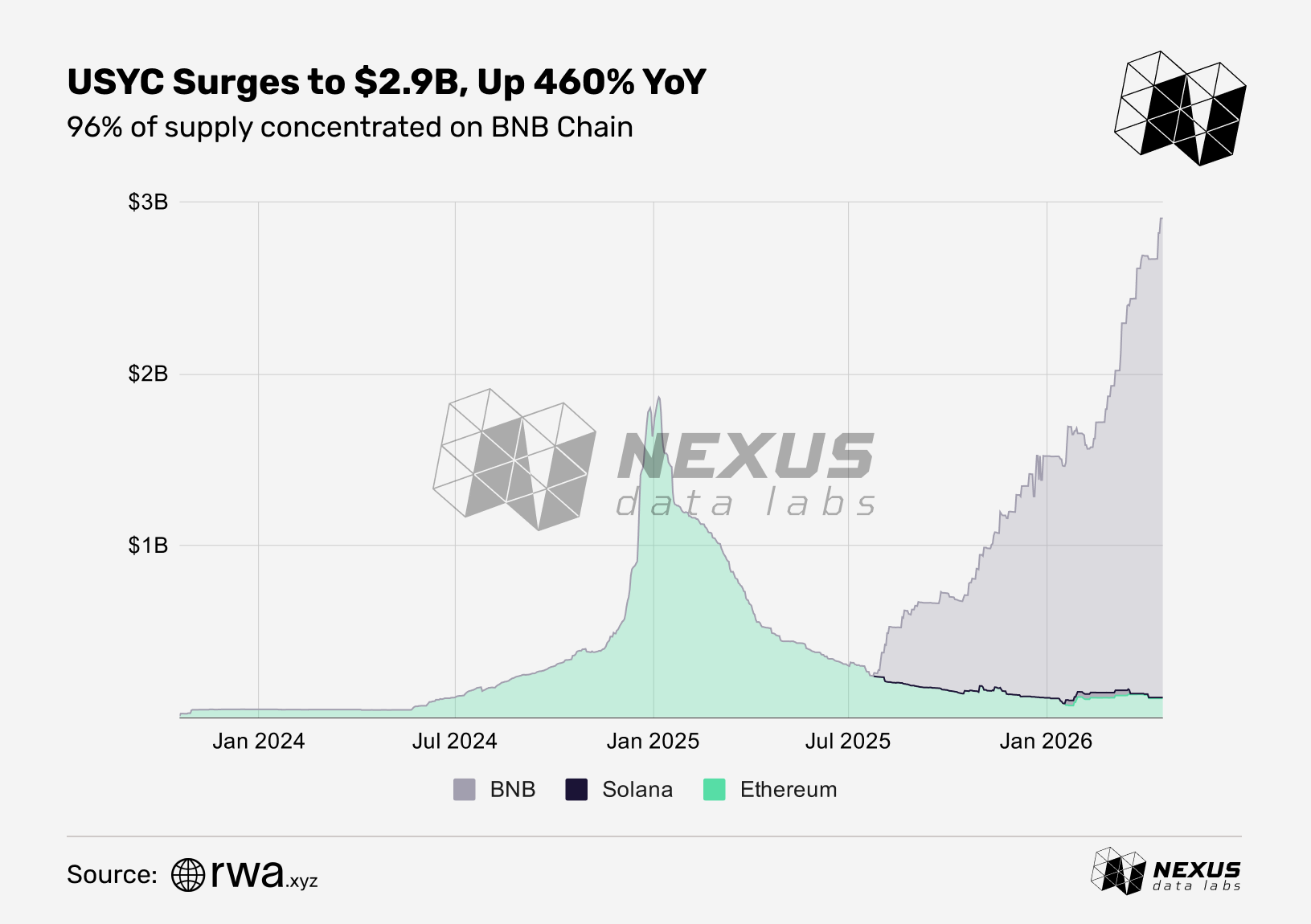
The growth is concentrated on a single chain and a single use case. 96% of supply ($2.79B) sits on BNB Chain as off-exchange collateral for Binance’s institutional derivatives business since its launch in July 2025. Ethereum supply, which peaked at $1.68B in January 2025, has since compressed to $110M.
sUSDe by Ethena
sUSDe staking ratio climbs to 60% as Ethena diversifies beyond funding rates
USDe is Ethena’s synthetic dollar, primarily backed by a delta-neutral strategy that pairs long spot positions in ETH and BTC with corresponding short perpetual futures to generate yield for sUSDe holders (Staked version of USDe).
While staked USDe supply has contracted from its $14B peak, the staking ratio climbed from 39% to 60%. Holders are increasingly locking up USDe for yield rather than holding it idle.
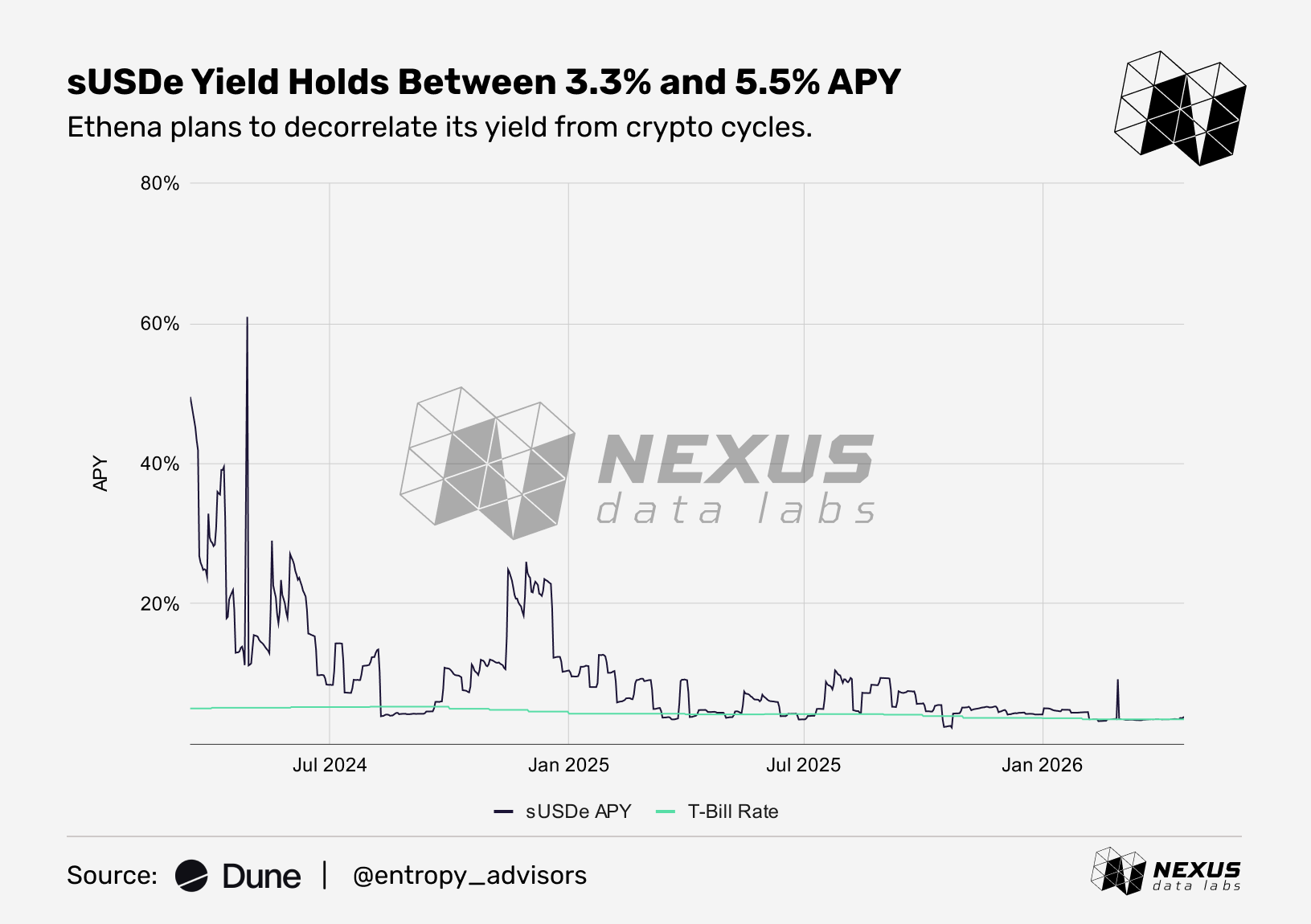
Yield has been modest, sitting in the 3.3-5.5% APY range since October 2025 as Q1 2026 average crypto perp funding fell to 1.74%. Ethena has been diversifying away from pure funding rate dependence by building USDtb to capture T-bill yield, but a prolonged bear market still makes sUSDe uncompetitive against direct T-bill rates and yield-bearing stablecoin alternatives like sUSDS.
A recent proposal from the Ethena Risk Committee expands yield sources to CeFi institutional lending, liquid RWAs beyond T-bills, equity and commodity basis exposure, and prime lending. Perpetual futures, once the primary return engine, now account for just 11% of backing.
If executed well, these new sources would decorrelate Ethena's yield from crypto cycles and provide a higher baseline yield for sUSDe. However, each new category introduces counterparty and credit exposures the pure delta-neutral model never had. In this case, the Risk Committee's sizing and monitoring become the load-bearing element of the new architecture.
BUIDL by Blackrock
Borja Neira | Website | Dashboard
BUIDL holds $2.5B as chain distribution shifts from Ethereum to Solana and BNB Chain
BUIDL is BlackRock's tokenized money market fund, offering institutional investors exposure to short-term US Treasuries through an onchain wrapper. It recently lost its lead position by market cap to USYC. BUIDL’s market cap peaked at $2.92B in May 2025 before drawing down to $1.74B by year-end. As of April 2026, market cap has recovered to $2.47B, roughly flat YoY but up $730M (+42%) YTD.
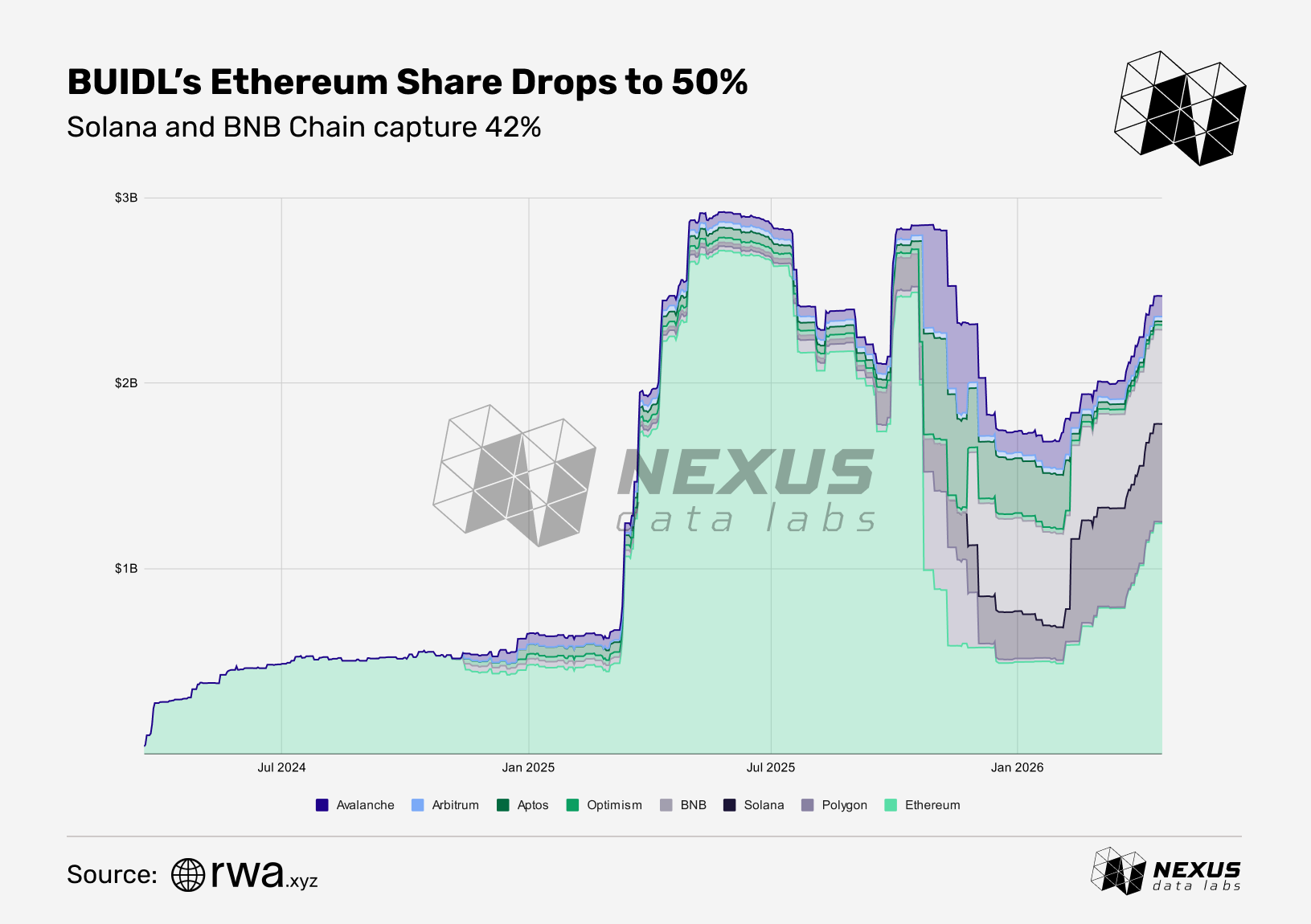
The recovery was not driven by Ethereum, where supply contracted from $2.25B to $1.24B over the past year. Instead, growth came from new chain deployments. Solana ($527M, 21%) and BNB Chain ($508M, 21%) now account for 42% of outstanding supply, up from zero 12 months ago. What was once a single-chain product now spans eight networks. The flat YoY growth headline obscures a meaningful structural shift in chain distribution underneath.
Closing Thoughts
Yield-bearing tokens are scaling fast. USYC crossed $2.9B in under a year, BUIDL now spans eight chains, and sUSDe's staking ratio climbed to 60% even as USDe supply contracted. Capital is not just moving onchain. It is increasingly being allocated toward productive yield once it arrives.
But AUM only tells part of the story. The next phase hinges on whether these tokens integrate into onchain liquidity, credit, and collateral layers. The tokens that earn their place in DeFi will be the ones that become more capital efficient and composable across lending, borrowing, and settlement.
As these tokens scale, the frameworks used to evaluate them must also evolve. A Treasury bill wrapped in a token, held on a specific chain, and managed by a specific issuer carries risks that traditional asset labels do not capture. Blockchain infrastructure risk and issuer risk are real. Ignoring either leads to an incomplete picture of what these tokens actually represent.
What We're Watching
Web3 Data Jobs
Nexus is partnering with Unchain Data to highlight opportunities across the onchain data ecosystem. This week’s featured openings: