


Intro
Welcome to the fourteenth edition of Nexus Data Labs, where we highlight what matters most in the fast-developing world of onchain finance.
Thank you to Ponyo, Filippo, Frederick, Rafi, and James for their contributions to this issue.
Setting the Scene
Tokenized equities are blockchain-native representations of traditional stocks, one of the world’s largest asset classes globally at approximately $100T in market capitalization. They generally fall into two categories: tokenized spot shares, which provide exposure to the underlying equity, and tokenized equity perpetuals, which track price movements without ownership.
As a category, tokenized equities represent one of the clearest convergence points between traditional financial markets and decentralized infrastructure. Compared to conventional brokerage accounts, they offer two structural advantages: DeFi composability and continuous, 24/7 global market access.
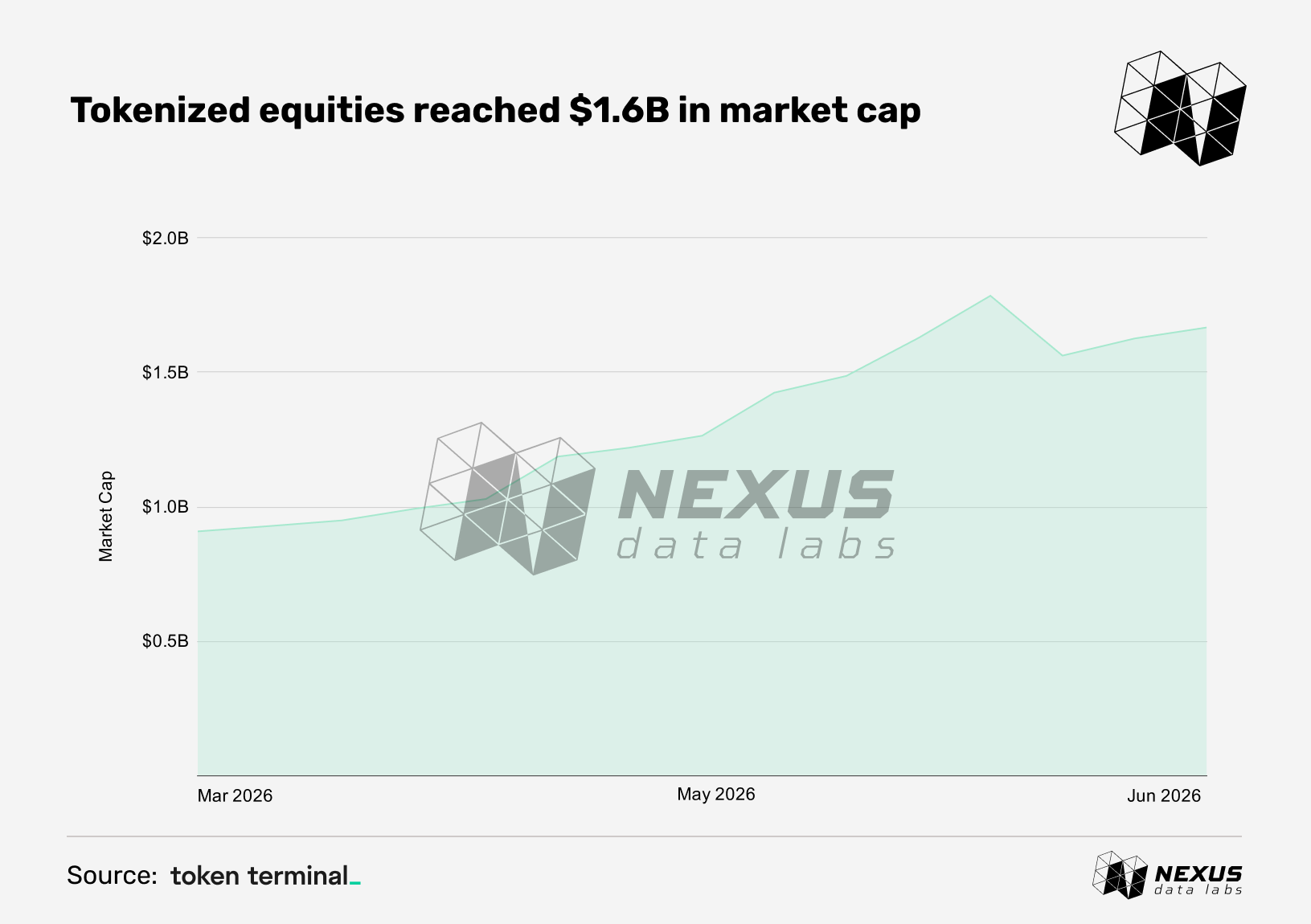
The sector has expanded rapidly. From effectively negligible levels in mid-2025, tokenized equities grew to $786M by March 2026 and have since doubled to $1.6B. This edition builds on our prior coverage by examining leading issuers, the emergence of perpetual markets trading beyond traditional hours, and the development of onchain access to pre-IPO exposure.
Ondo
Ondo Global Markets crosses $1B TVL with BNB Chain up ~10x YTD
Ondo Global Markets is a tokenization platform that issues onchain versions of U.S. stocks and ETFs, each backed 1:1 by the underlying security. The platform has scaled to approximately $1.1B in total value locked (TVL), with growth accelerating through 2026 and BNB Chain emerging as the fastest-growing venue, expanding roughly 10x YTD.
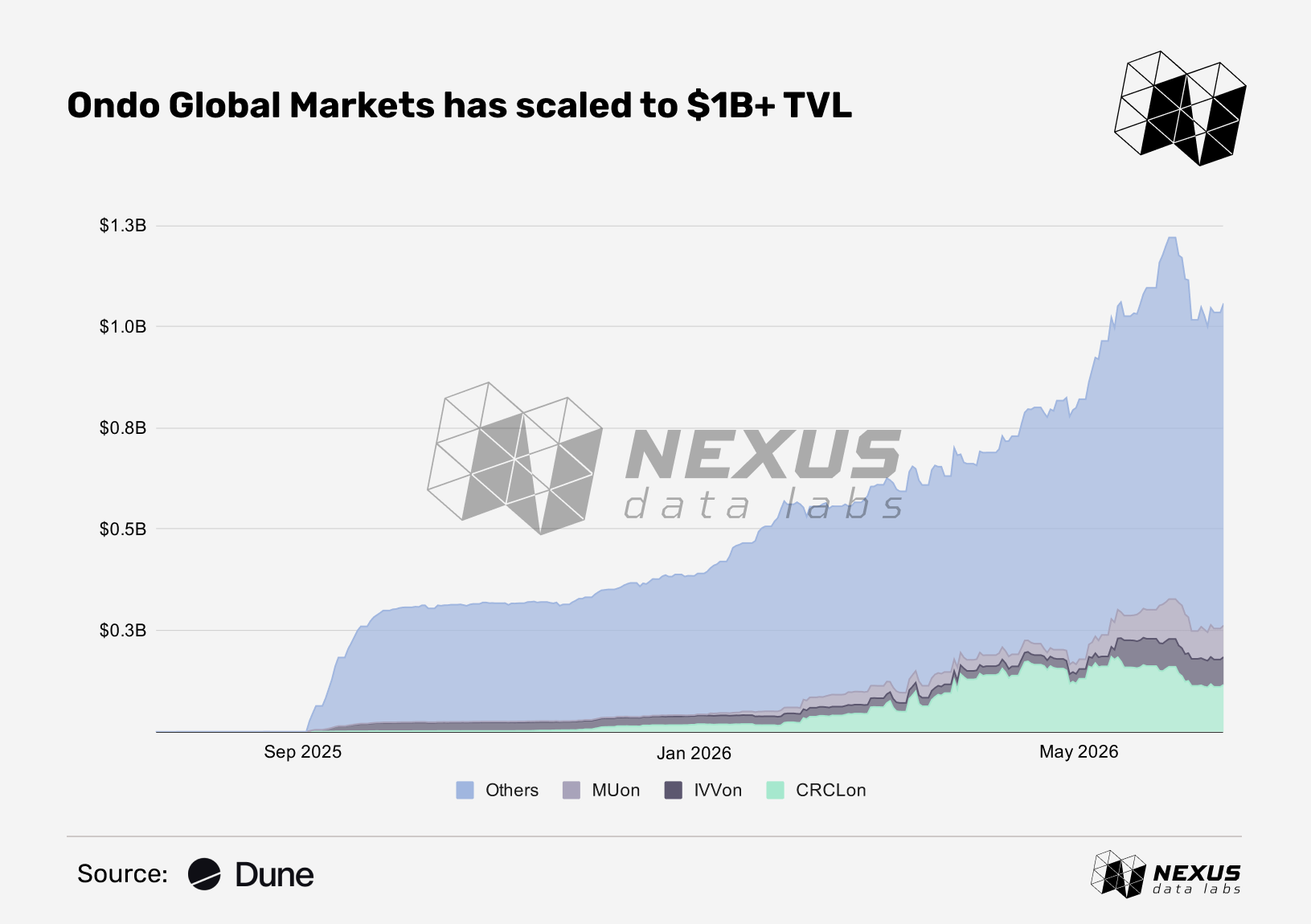
Ethereum remains the primary network, accounting for more than half of total TVL, followed by BNB Chain at approximately $400M and Solana at around $22M, while HyperEVM remains negligible. Asset concentration skews toward single-name equities: Circle leads at $116M, followed by Micron at $84M, with the iShares Core S&P 500 ETF ranking third at $68M.
Despite being onchain assets, trading activity remains overwhelmingly centralized, with $12.9B in volume on CEXs compared to $150M on DEXs. Binance alone custodies $180M of the $281M held on exchanges. Meanwhile, adoption continues to broaden, with the holder base growing from roughly 20K to over 120K YTD, making tokenized equities the most widely held segment within tokenized RWAs.
xStocks
Frederick | Website | Dashboard
xStocks accounts for 76.9% of Solana’s $429M tokenized stock market
xStocks is the dominant tokenized equity issuer on Solana and the second largest across all chains. On Solana, the protocol accounts for $330M in market cap, or 76.9% of the chain’s $429M tokenized stock market, with a holder base of 222K.
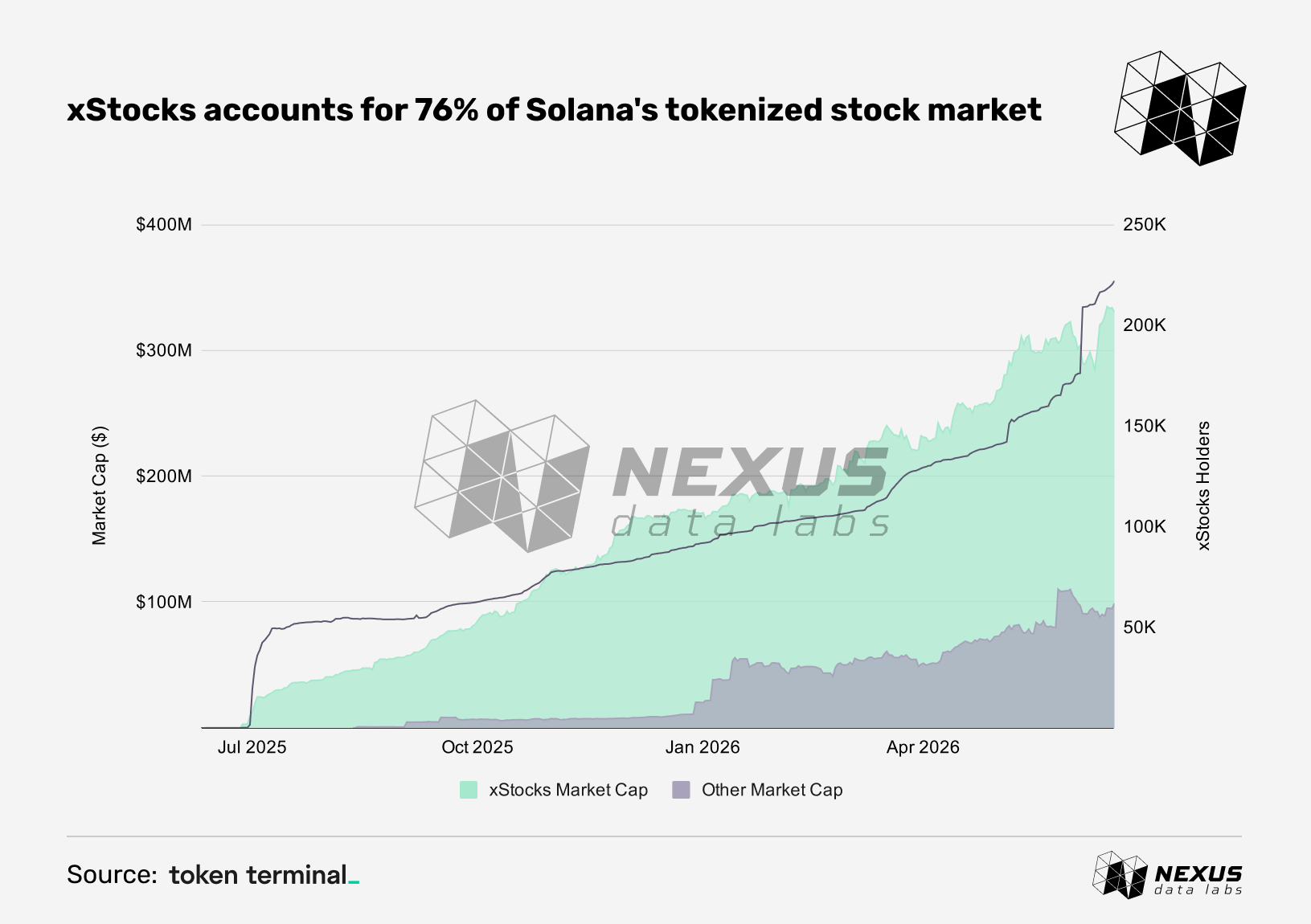
Since July 2025, market cap has increased 27x, from $12M to $330M, while holders have grown roughly 11x, from 20K to 222K. Although competing issuers on Solana have gained traction since late 2025 and now total $99M in combined market cap, xStocks’ market share has remained steady at around 77% since January 2026. The average holder position has also risen about 2.4x, from $626 to $1,486, suggesting that users are not only entering the market but also allocating more capital to xStocks over time.
Securitize
66% of Securitize's revenue was concentrated in BCAP and BUIDL in May 2026
Securitize is a tokenization platform that issues onchain versions of traditional assets, including funds and other securities. Its flagship product, BUIDL, is one of the largest tokenized treasury funds in the market. May 2026 marked a breakout month for the platform, with gross protocol revenue surging 48.1% MoM to $5.9M and earnings increasing 30% to $2.9M.
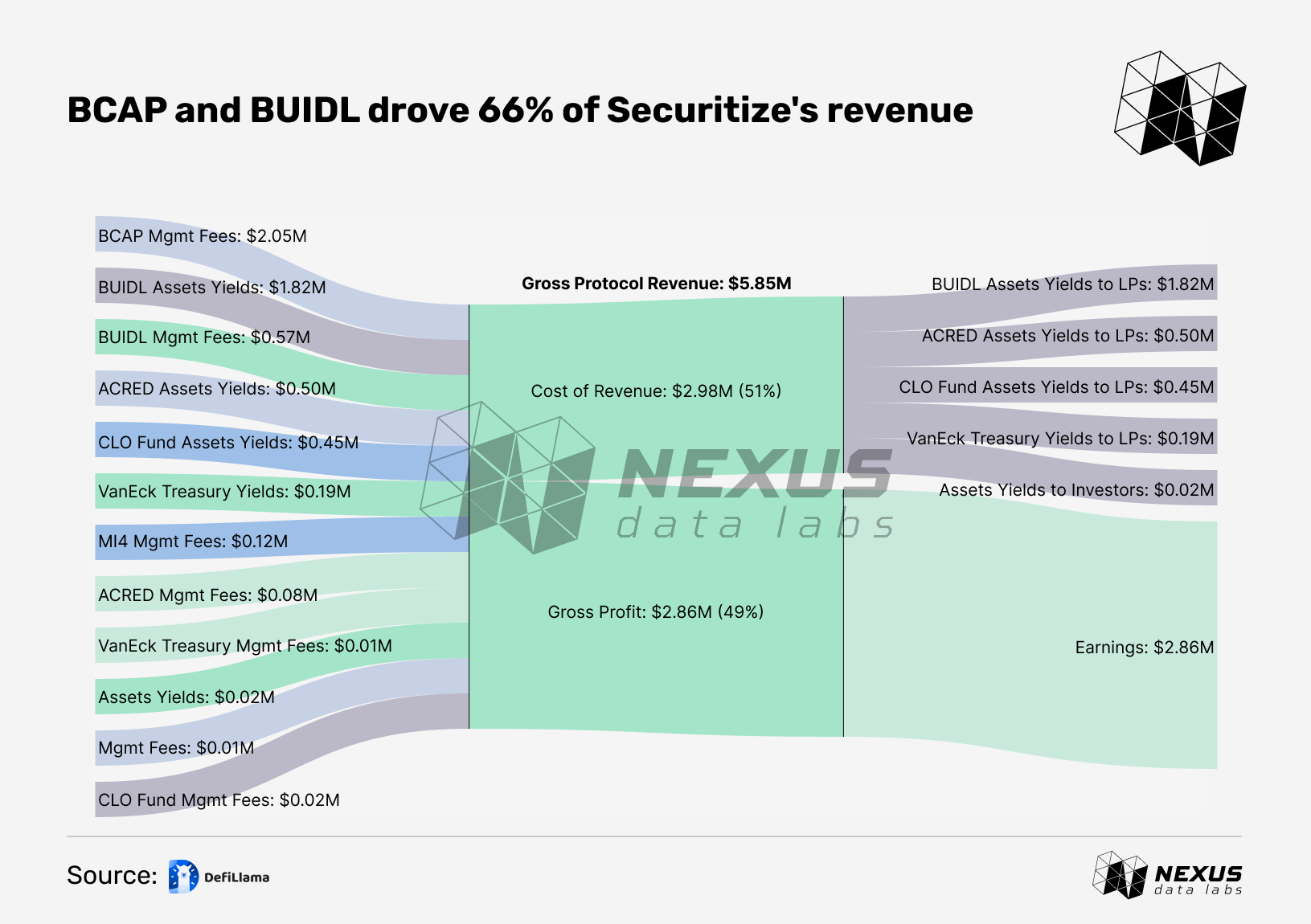
Revenue composition was nearly evenly split between management fees (49.2%) and underlying asset yields (50.7%), but product concentration remained high. BCAP was still the platform’s primary management fee driver at $2.1M, or 35% of total revenue, while BUIDL was the leading yield-generating product at $1.8M, or 31% of total revenue. Together, those two products accounted for 66% of revenue.
Pre-IPO Markets
Pre-IPO perps peaked 36% to 61% above Polymarket's implied valuation, then converged toward it by IPO day
Pre-IPO perps are synthetic contracts that give traders exposure to a private company’s implied valuation before it lists. Unlike prediction markets, they trade more like leveraged instruments and are shaped by funding, leverage, and order-book dynamics rather than a single binary outcome.
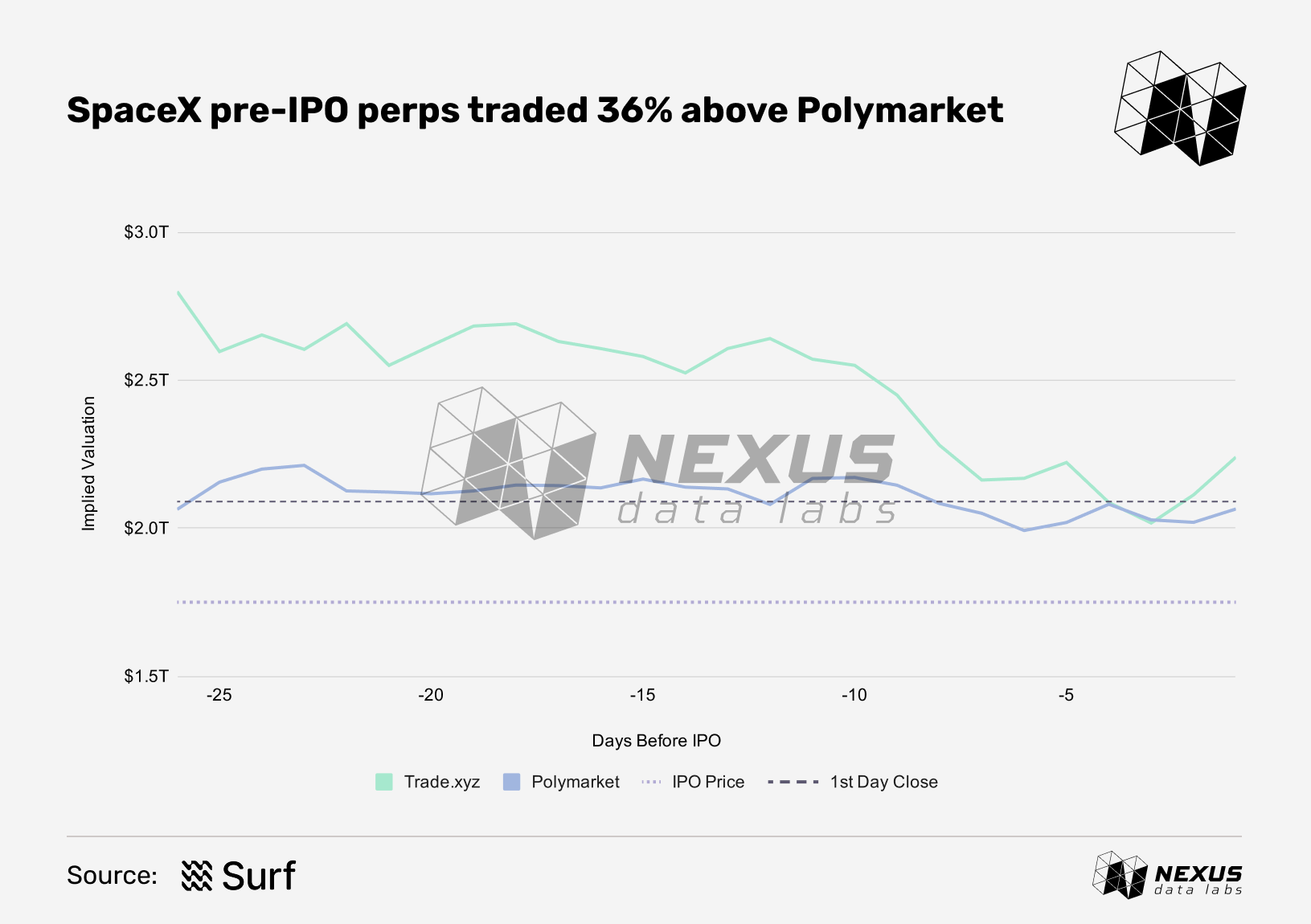
The data suggests that prediction markets serve as a useful price anchor for pre-IPO valuation. In the two completed Hyperliquid cases, Trade.xyz perps traded at a persistent premium to Polymarket's implied valuation, peaking at 36% above for SpaceX and 61% above for Cerebras before converging toward parity or slightly below by IPO day.
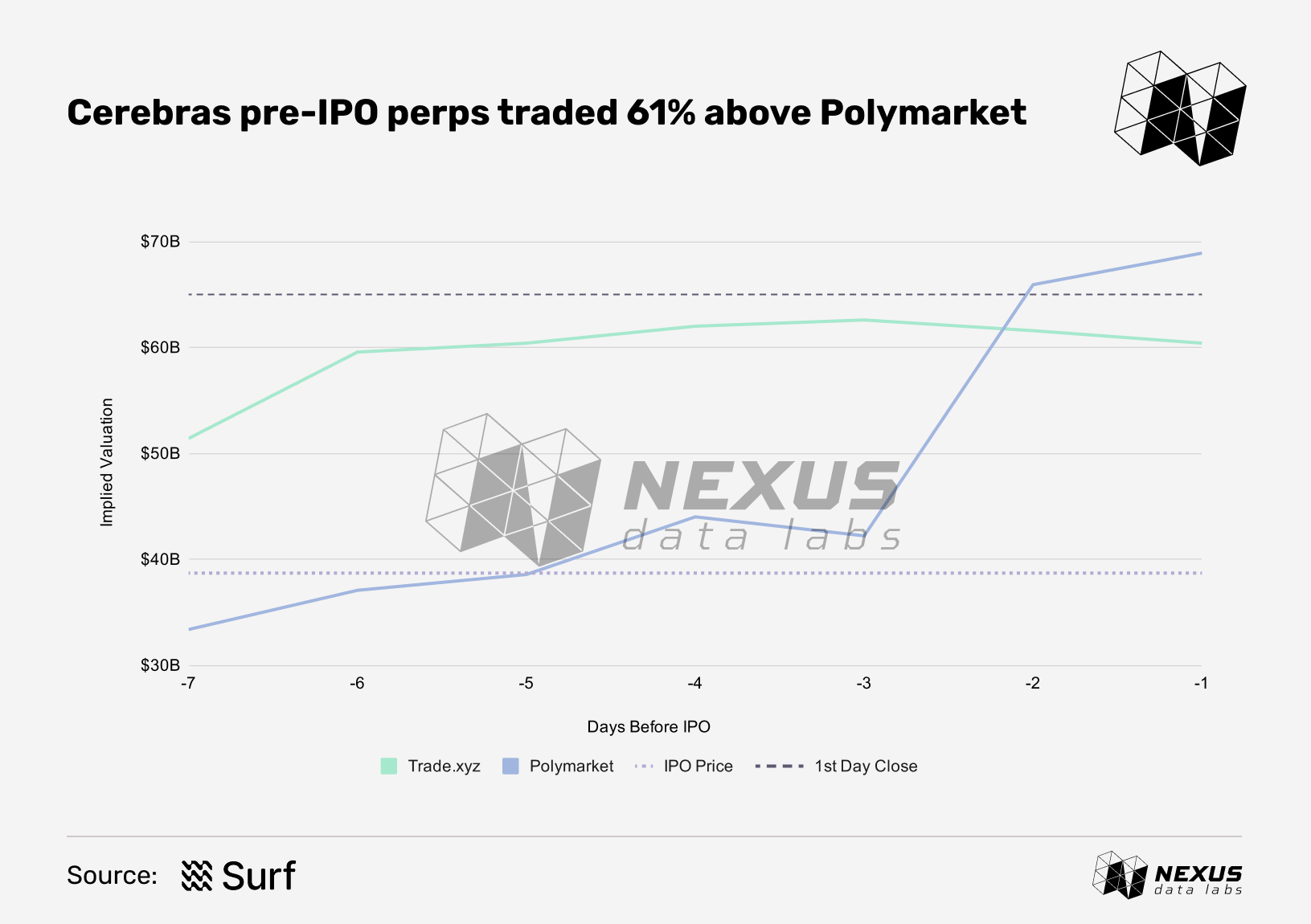
That divergence reflects market structure, not superior information. In SpaceX, turnover was $800M on Trade.xyz vs $18M on Polymarket, and in Cerebras, it was $47M vs $0.3M. In both cases, the perp market was leveraged, funding-driven, and thinly booked at listing, which made it prone to overshooting before correcting as funding costs and arbitrage pressure set in. Polymarket, by contrast, used far less capital, but each dollar represented outright exposure to a bounded, resolution-anchored payoff, which kept pricing more calibrated and better aligned with the eventual IPO clearing price. More capital made the perp noisier, not smarter, and the smaller prediction market was the better predictor.
Korean Equity Perp Markets
Samsung’s weekend perp called 94% of Monday opens, but the signal did not generalize
Korean equity perpetual markets provide synthetic exposure to major Korean stocks. Even when the Korean exchange is closed, onchain equity perp markets are not, creating a natural experiment for whether weekend price formation carries into Monday’s open.
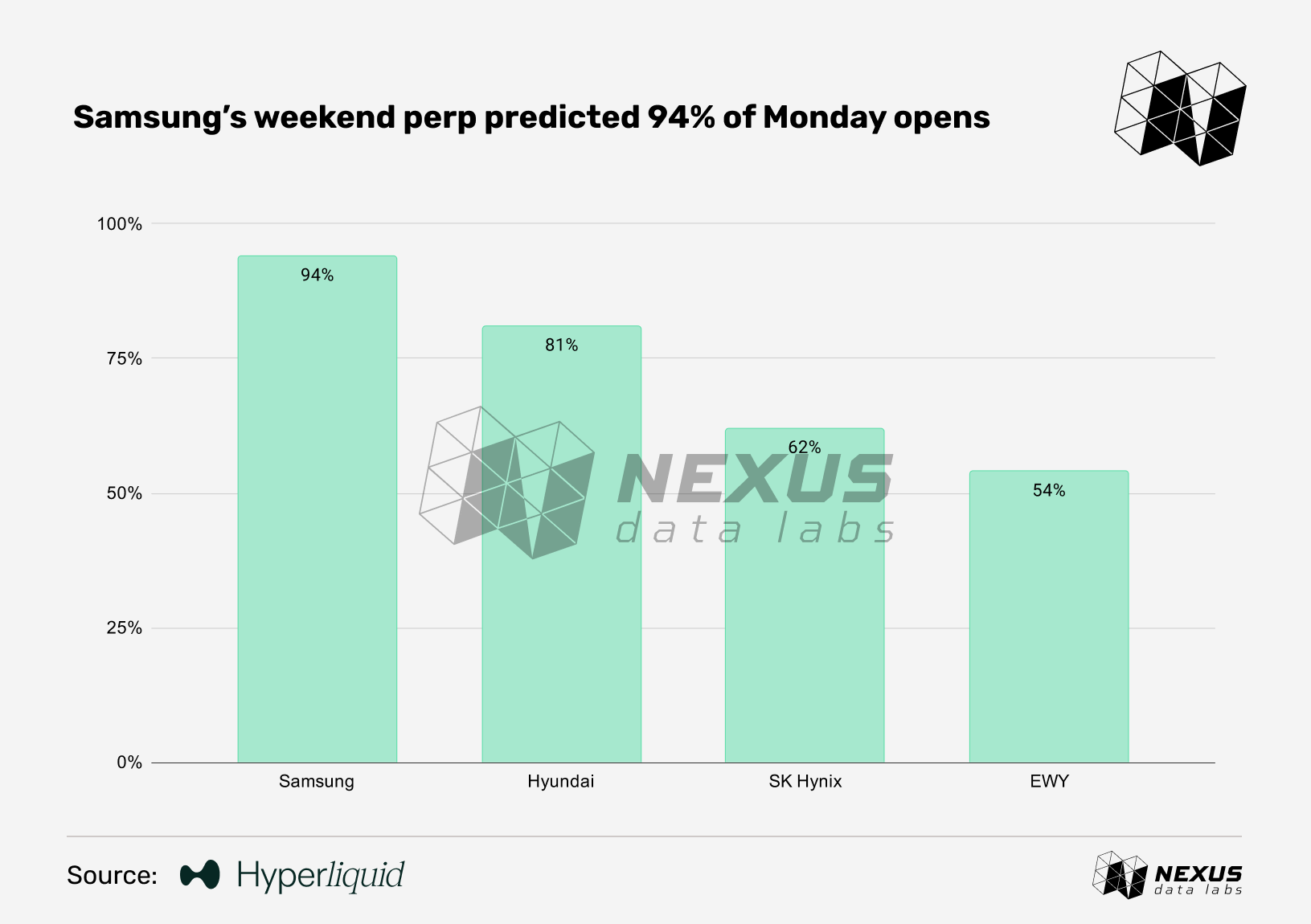
Across 62 weekends and four Korean equity perp markets, Hyperliquid correctly predicted the direction of Monday’s open 45 out of 62 times, for an aggregate hit rate of 73.8%. Performance, however, varied widely by asset. Samsung stood out at 15 out of 16, or 94%, with strong statistical significance. Hyundai reached 13 out of 16, but lost statistical significance after adjusting for its structural Monday downside bias. SK Hynix performed more weakly at 10 out of 16, while EWY lagged at 7 out of 13.
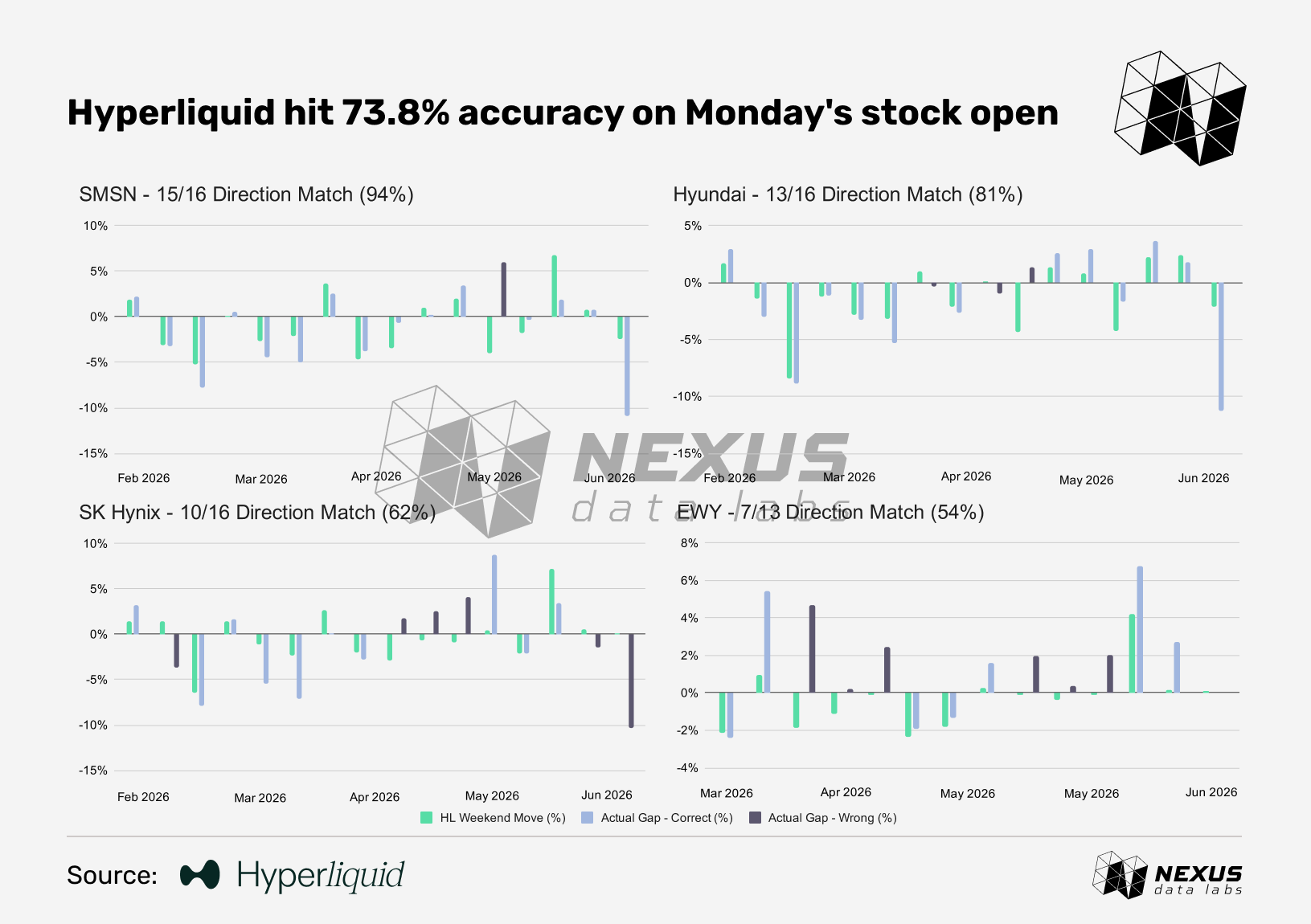
The signal does not generalize. Some names show strong alignment with Monday opens, but the effect is not uniform, suggesting that any predictive value is selective rather than market-wide.
Closing Thoughts
Tokenized equities are still early, but the direction is clear: TVL is rising, new entrants are arriving, and the market is starting to feel more crowded. What began as a niche experiment is increasingly becoming a real category, with enough scale to attract both issuers and traders.
At the same time, concentration remains high. Revenue and chain activity are still heavily skewed toward a small number of products and networks, and trading remains dominated by centralized venues. That concentration is not necessarily a weakness at this stage, but it does suggest the market is still organizing around a few clear winners rather than a broad, distributed ecosystem.
That is also what makes the space worth watching. The real opportunity is not simply to recreate equities onchain, but to build something traditional markets do not already offer: DeFi composability, new market structures, and experiments that extend stock exposure beyond brokerage rails. If tokenized equities are going to matter long term, it will be because they become more than just a wrapper around existing assets.
What We're Watching
Web3 Data Jobs
Nexus is partnering with Unchain Data to highlight opportunities across the onchain data ecosystem. This week’s featured openings:
