


Intro
Welcome to the sixteenth edition of Nexus Data Labs, where we highlight what matters most in the fast-developing world of onchain finance.
Thank you to Diego, Rizwan, and Sam for their contributions to this issue.
Setting the Scene
Stablecoins have found their use case in crypto. Their role is now well established. The focus has shifted to structure: who issues them, what backs them, and how those design choices translate into risk, yield, and regulation.
Today’s stablecoins span a wide range of collateral models, including fiat reserves, US Treasuries, crypto collateral, tokenized real-world assets, and delta-neutral strategies. Each carries a different trade-off between stability, scalability, and transparency.
Despite this expanding design space, no challenger has come close to displacing the incumbents. USDT and USDC still account for roughly 87% of circulating supply, a duopoly that has survived multiple market cycles and outlasted every serious competitor.
This week’s edition examines the two giants: USDT and USDC.
Sector Overview
Stablecoin supply contracted modestly in H1 2026 as USDT and USDC lost share
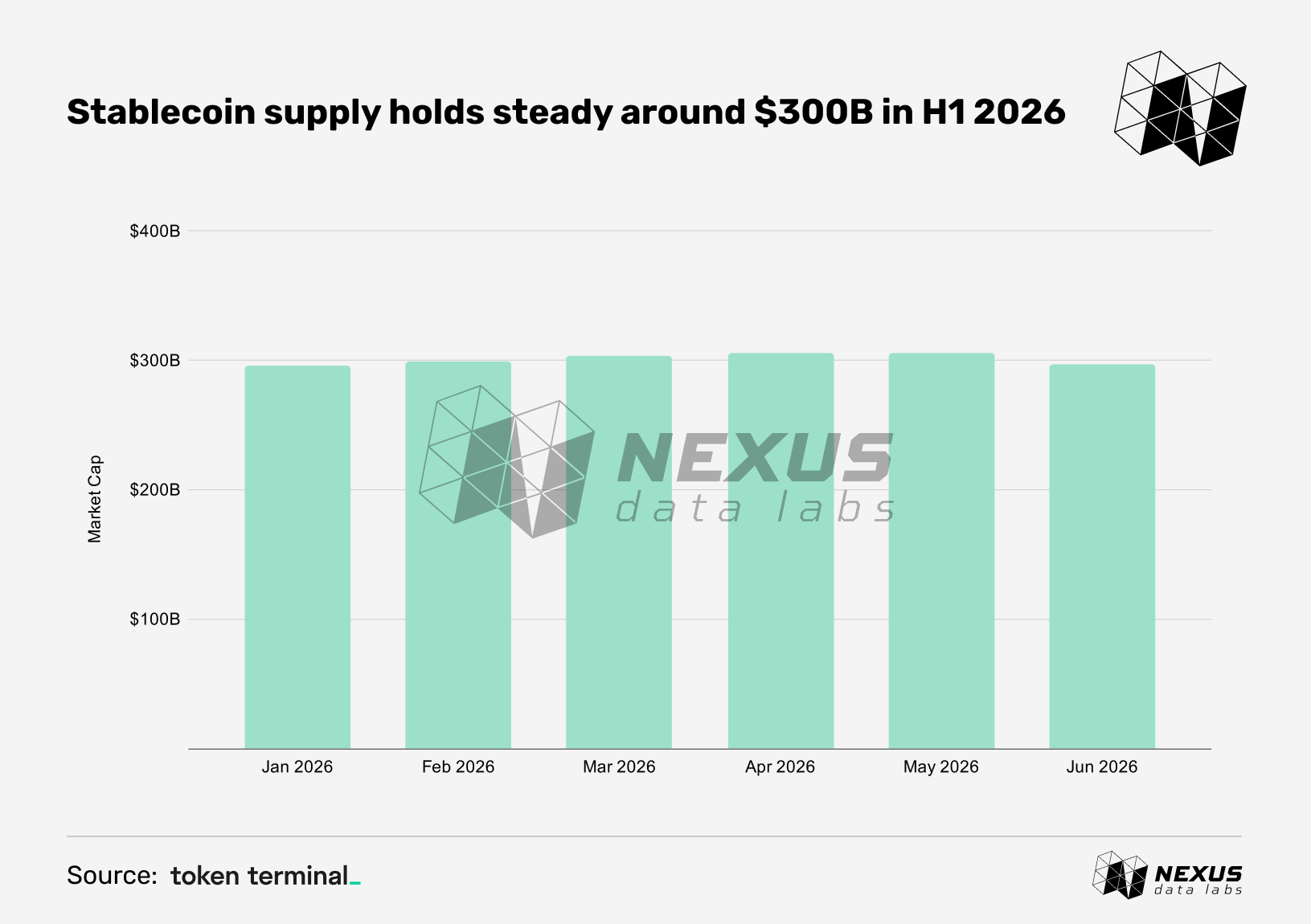
Total circulating market cap ended the first half at $297B, down 0.78% from $299B at the start of the year. The path was not linear: supply peaked near $306B in late April before retracing through May and June.
The Big 2, USDT and USDC, lost ground in both absolute terms and market share. Their combined share declined from 87.33% to 86.64% over H1, a 69 bps drop. USDT fell by $2.49B to $184B, while USDC declined by $1.58B to $73B.
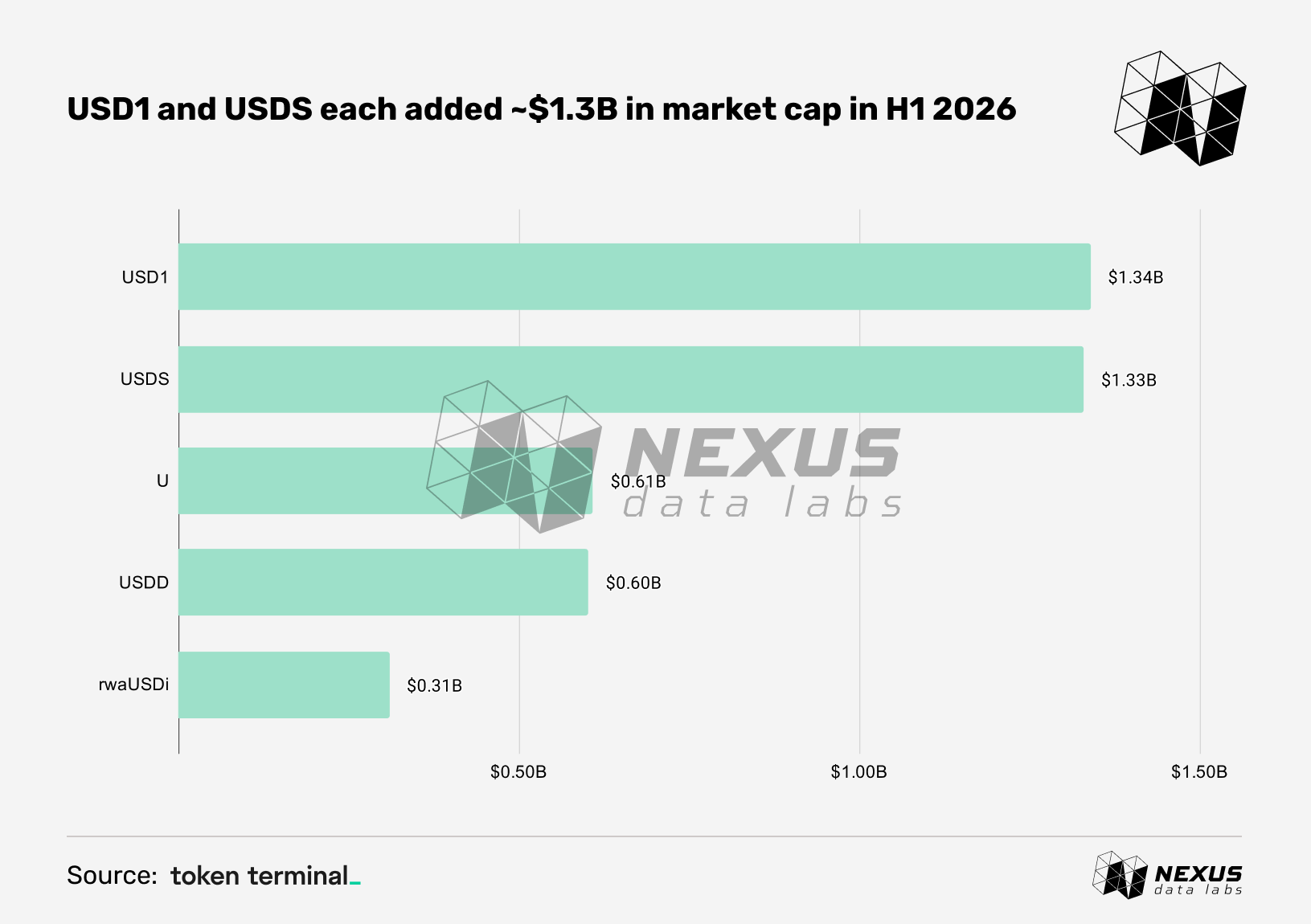
That capital did not leave the market. It rotated into the largest H1 2026 gainers:
USDS: $10B (+$1.3B)
World Liberty Financial USD1: $4.6B (+$1.3B)
USDD: $1.2B (+$600M)
United Stables U: $1.0B (+$610M)
Multipli rwaUSD: $360M (+$310M)
USDT
USDT maintains ~60% share as holders grow to 191M
USDT remains the dominant stablecoin, with a circulating market cap of roughly $184B, representing around 60% of total supply. Adoption continued to expand in H1 2026: unique holders increased about 25% from 152M to 191M, while monthly active addresses rose roughly 8% from 33M to 35M.
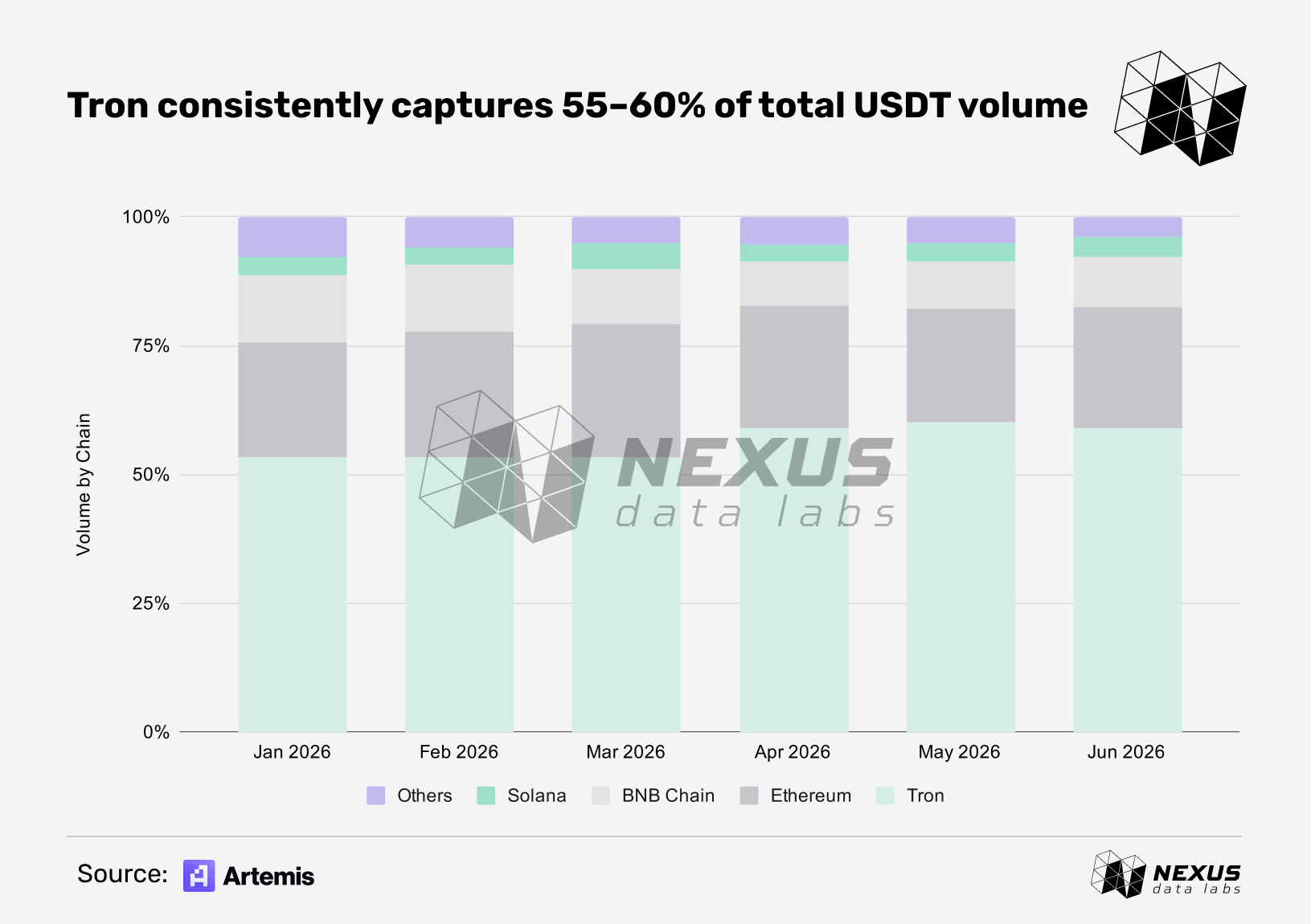
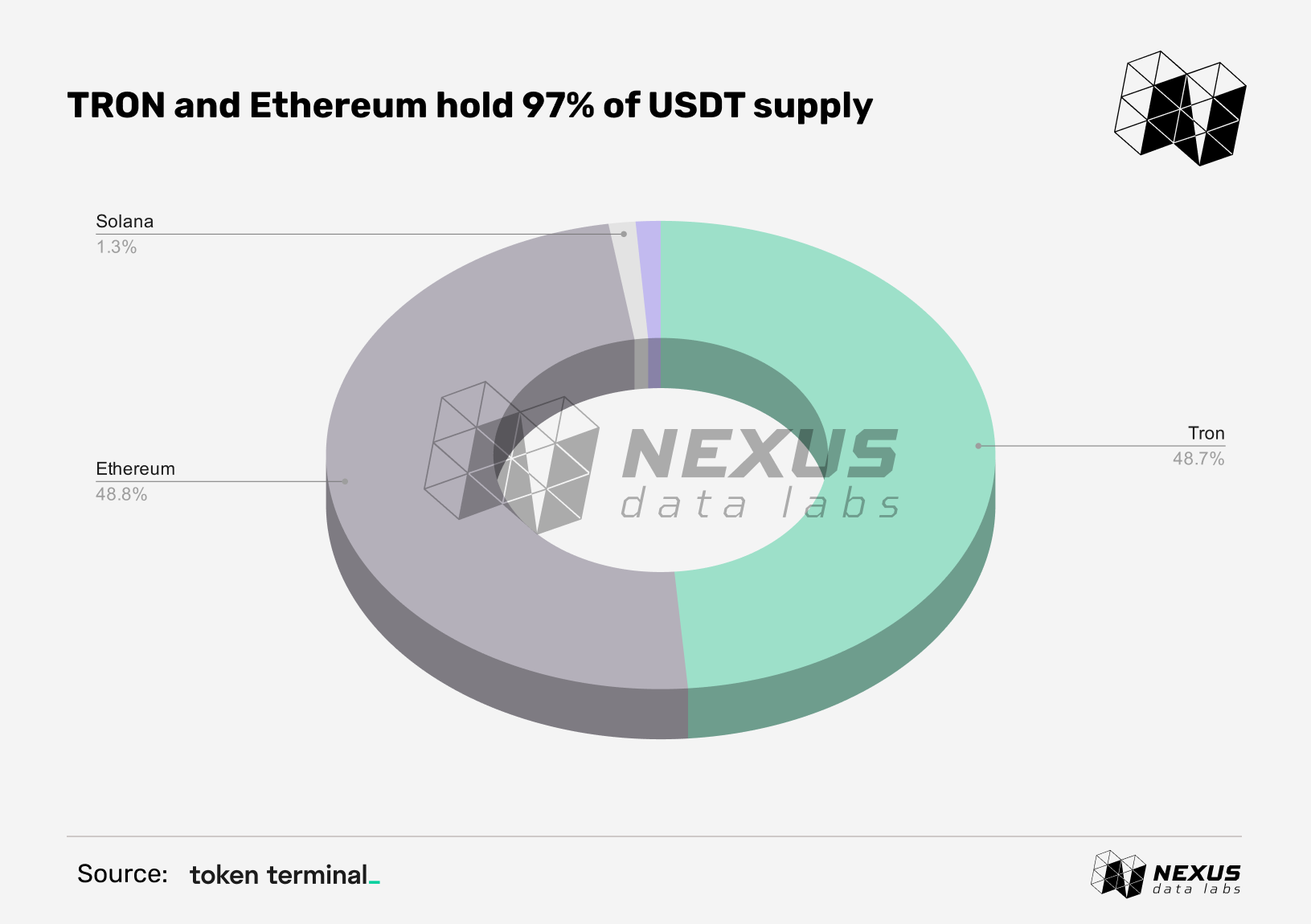
By blockchain, Ethereum holds approximately $90B in USDT supply, followed by TRON ($89B) and Solana ($2.4B). Network activity remains robust, with USDT averaging $37B in daily transfer volume. YTD transfer volume totals $6.8T, with TRON at 56% ($3.84T), Ethereum at 24% ($1.60T), and BNB Chain at 11% ($733B), the remainder distributed across other supported networks.
USDC
USDC tops $73B supply: Ethereum leads the capital, Solana and Base drive the activity
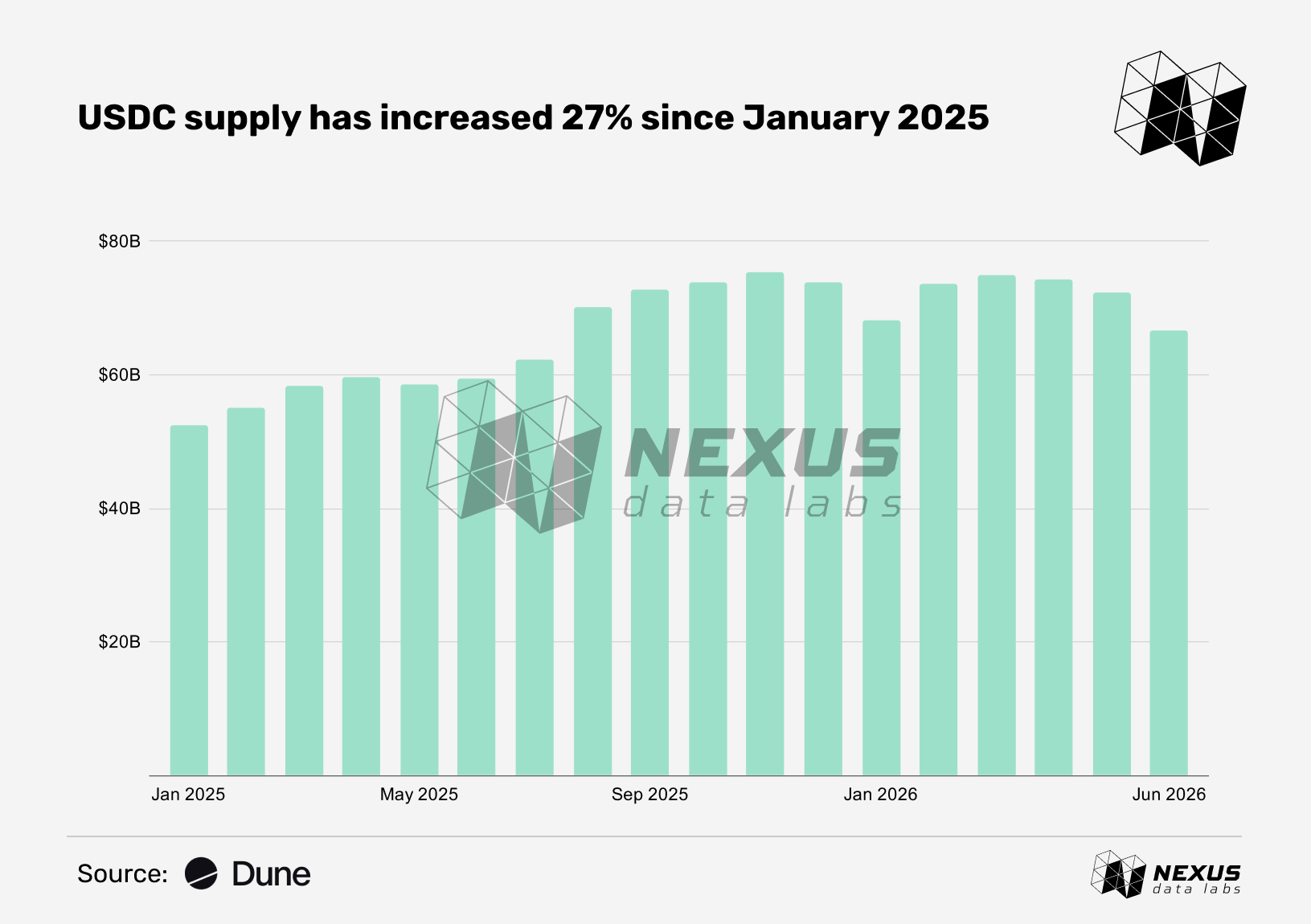
USDC circulating supply reached $73B, representing 24.5% of the $297B stablecoin market. The base has been building for over a year: native issuance on Ethereum grew from $34B at the start of 2025 to $51B by June 2026, housing roughly 70% of all USDC, while Solana ($7.7B) and Base ($4.2B) round out the top three.
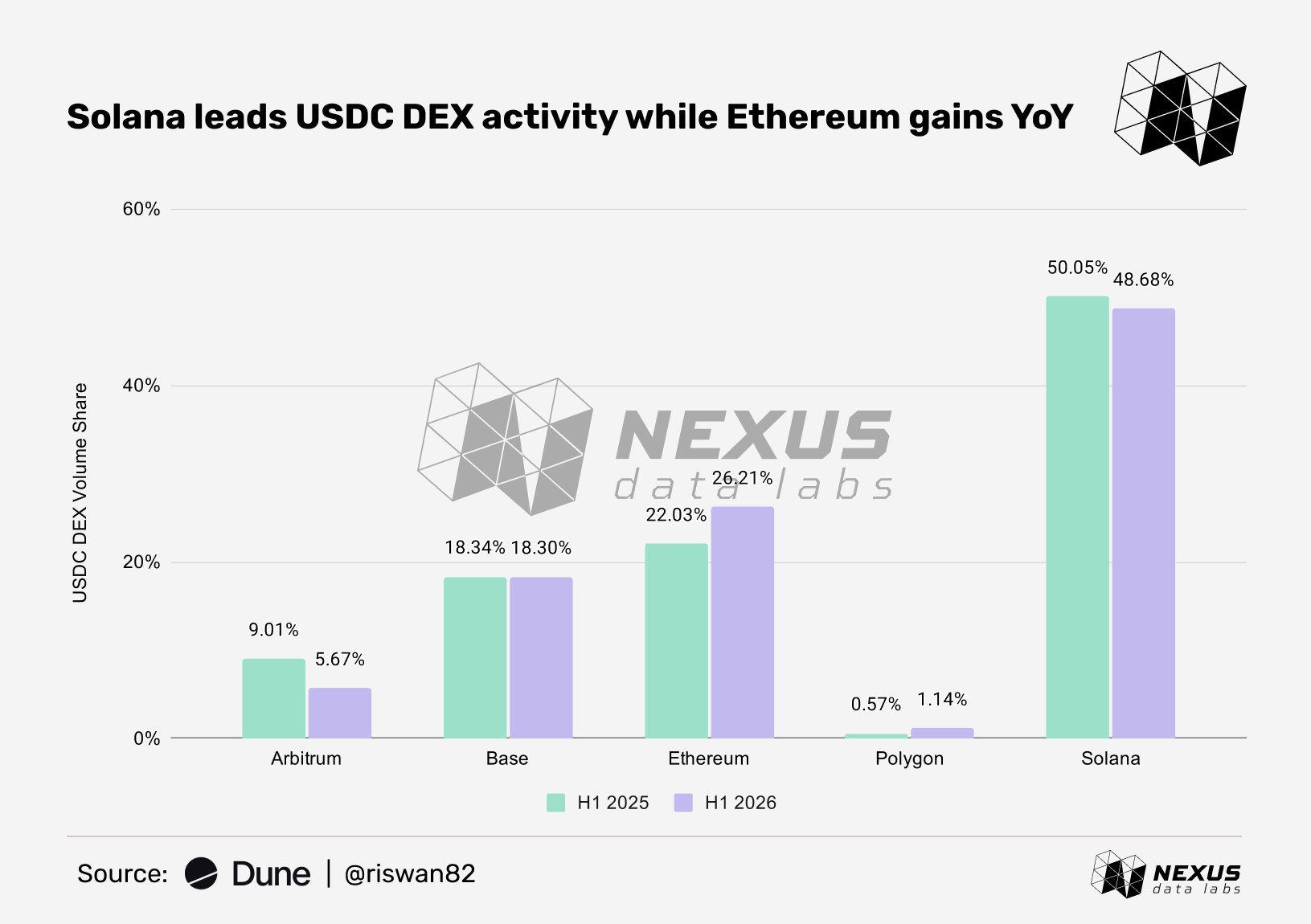
DEX activity presents a different picture. USDC on Solana continues to dominate trading, accounting for close to half of DEX volume, even as that share has edged down year on year. USDC trading activity on Ethereum has moved in the opposite direction, with its volume share rising from 22.03% to 26.21%, while Base held steady at 18.3%. Declining volumes alongside rising trade counts on Base and Ethereum suggest smaller average trade sizes, more consistent with retail flow than institutional execution. Capital remains concentrated on Ethereum, while USDC activity is increasingly distributed across Solana and Base.
Closing Thoughts
Institutional capital is entering the stablecoin market in force. Banks, asset managers, and payment networks that once observed from the sidelines now want a share of it.
Yet the market they are entering is still a duopoly. USDT and USDC account for roughly 87% of circulating supply, and that dominance extends beyond first-mover advantage. Both benefit from deep liquidity across major venues and a track record of maintaining their pegs through stress events that unseated many challengers.
Recent consortium-led efforts such as OpenUSD show that well-capitalized entrants recognize the opportunity. What remains unproven is whether institutional backing can translate into the liquidity and trust the incumbents have built. Greater issuer diversity would benefit users, but the market has so far shown how difficult that is to deliver.
What We're Watching
Web3 Data Jobs
Nexus is partnering with Unchain Data to highlight opportunities across the onchain data ecosystem. This week’s featured openings:
