


Intro
Welcome to the eighteenth edition of Nexus Data Labs, where we highlight what matters most in the fast-developing world of onchain finance.
Thank you to Diego, Filippo, and Oğuz for their contributions to this issue.
Setting the Scene
Robinhood has spent years building a retail investor base. Now, it is building the infrastructure to bring that audience onchain. Robinhood Chain launched its mainnet on July 1, and just over a month later, its early metrics already place it ahead of most L2 launches this cycle.
The chain is only the foundation. What Robinhood builds on it matters more. Tokenized stocks were the headline use case at launch, giving users onchain exposure to equities directly through the company's own product. So far, most tokenized shares appear to be held rather than actively used across DeFi. That is the gap: the distance between what the infrastructure enables and how it is actually being used.
This edition covers Robinhood Chain's growth since launch, the mechanics of its tokenized stock offering, and whether those assets are finding use beyond simple custody.
Overview
Robinhood Chain's TVL reaches $435M
Robinhood Chain's TVL has climbed to $435M since its mainnet launch, making it the third-largest Ethereum L2, behind only Base and Arbitrum and ahead of OP Mainnet and Starknet.
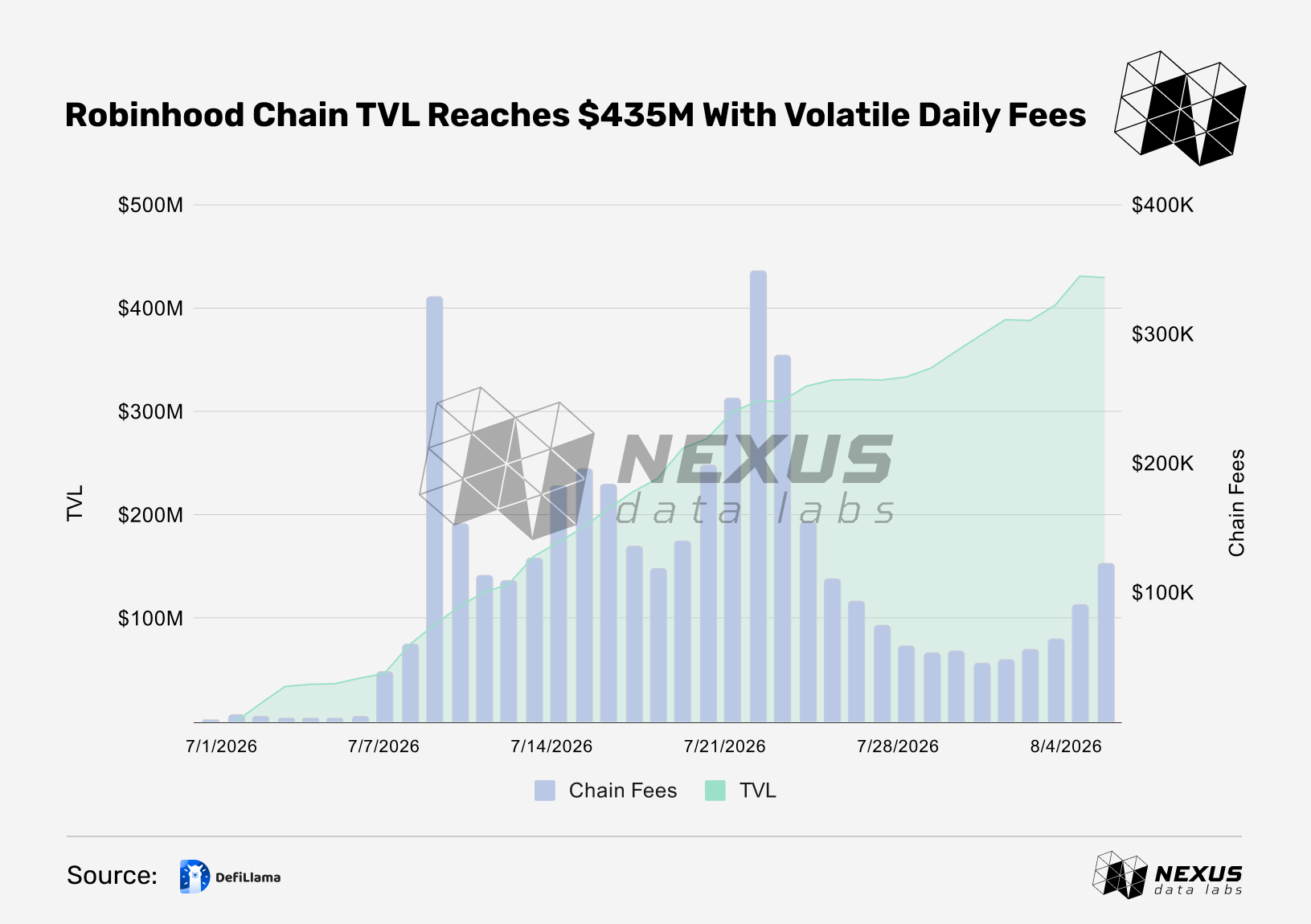
Growth has not been steady. Chain fees spiked during periods of increased activity, particularly on July 10 and July 23, rather than following a smooth upward trend. Liquidity is also concentrated among a few protocols. Steakhouse Financial ($360M) and Morpho ($346M) are the two largest, while Uniswap trails at $76M.
Editor's note: DeFiLlama’s methodology excludes risk curator protocols such as Steakhouse Financial from the chain’s TVL.
Tokenized Stocks
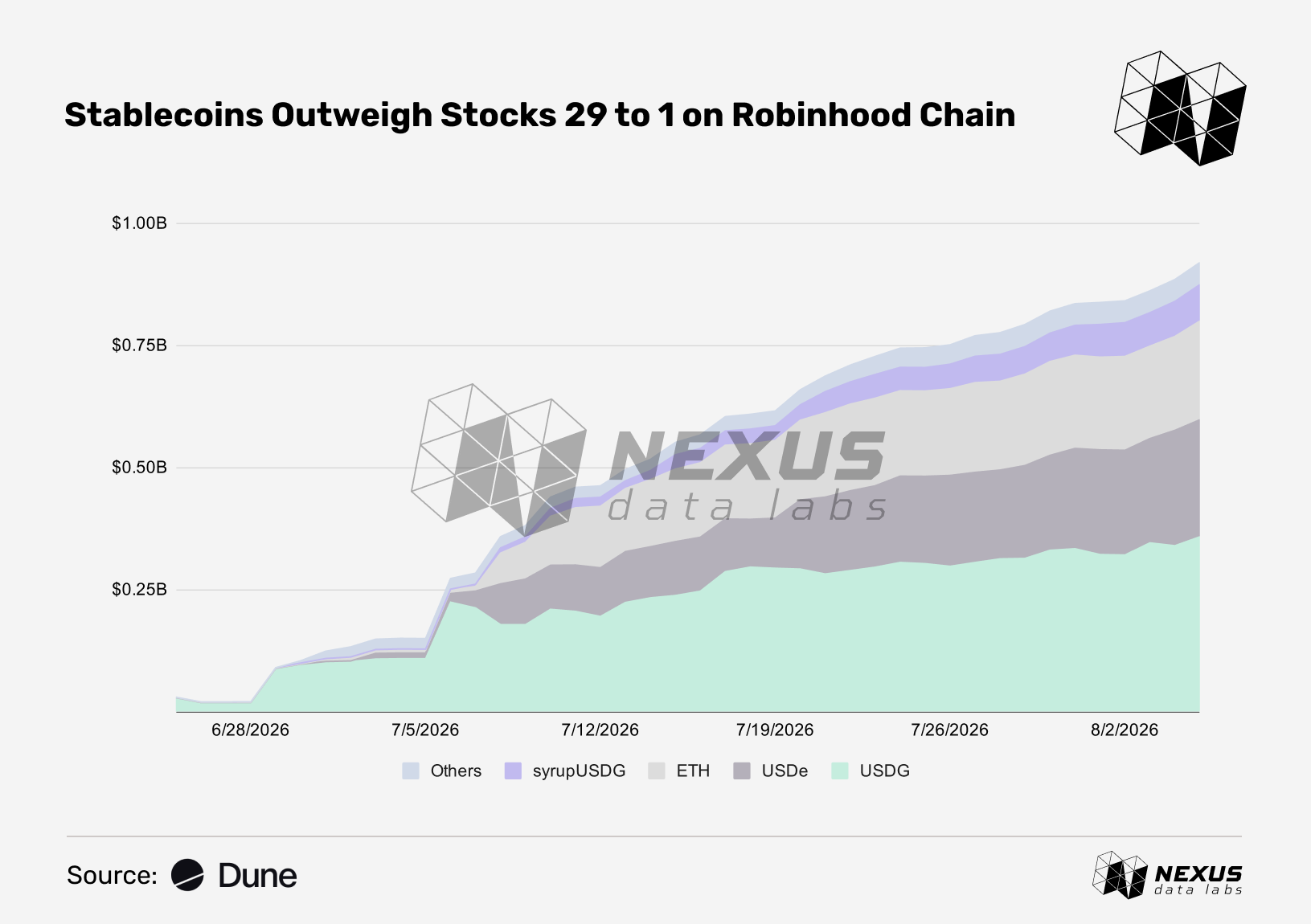
Tokenized stocks account for 2.6% of Robinhood Chain’s $897M in assets
Robinhood Chain holds $897M in priceable assets, 97% of which consists of stablecoins and bridged ETH. Tokenized equities account for only $22.9M. They also represent a small share of activity, making up 1.5% of the chain's $18.7B in DEX volume, compared with 81% for memecoins.
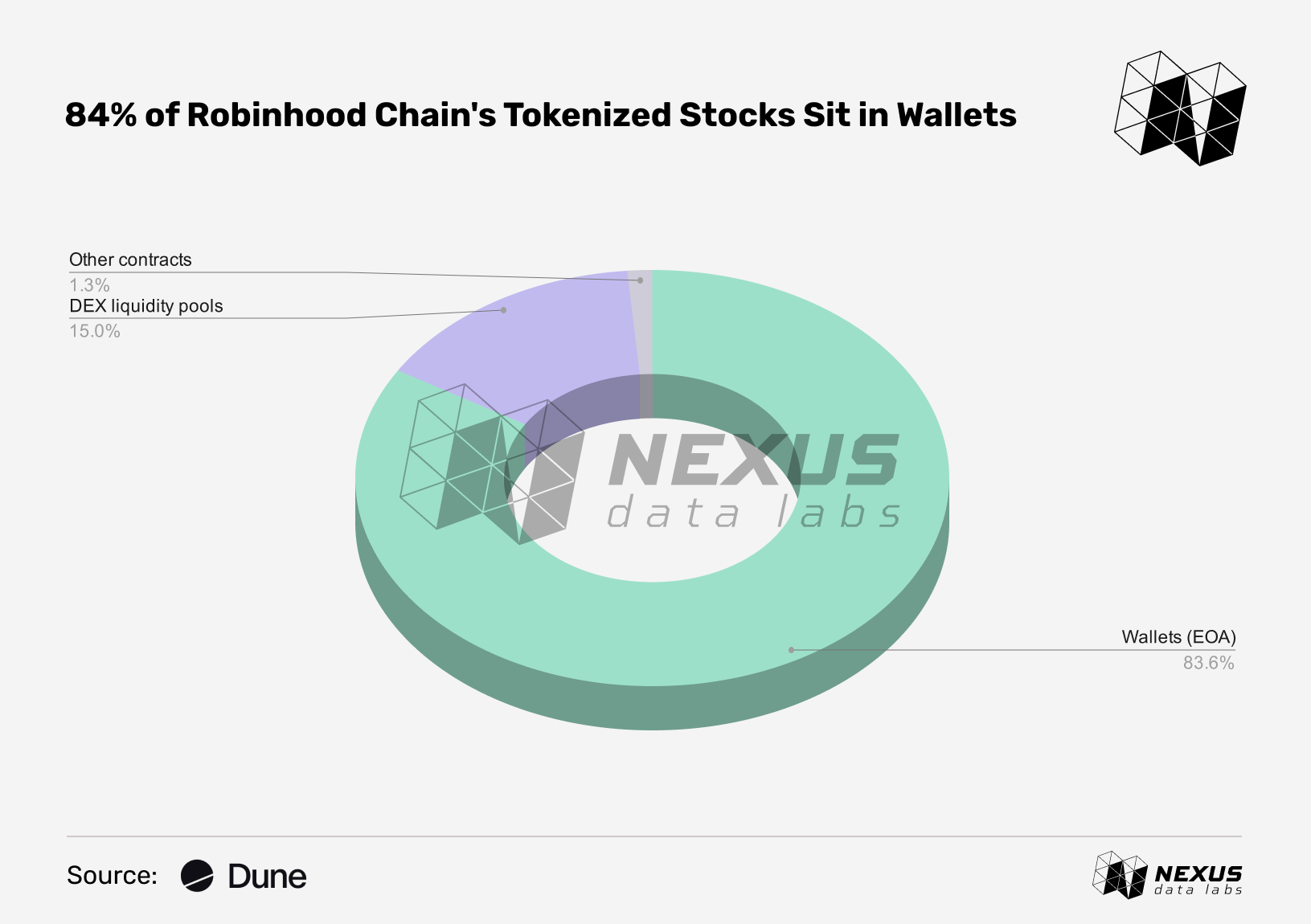
Ownership is broad but largely passive. More than 52,000 wallets hold tokenized equities, yet 84% of the value sits in wallets rather than in DeFi. Another 15% provides DEX liquidity. This measure counts DEX liquidity pools and Morpho collateral as active DeFi use.
Lending makes the gap between infrastructure and demand particularly clear. Morpho has 38 live markets that accept tokenized stocks as collateral, including several created this month. Yet those markets hold only $1,486 in collateral across 11 addresses. The venue for equity-backed credit exists on the chain, but demand has not arrived yet.
Tokenized Stocks in Practice
14% of tokenized stocks account for 97% of the value
Robinhood Chain has tokenized 203 U.S. stocks so far. But the market remains narrow: 106 stocks have never been minted, and the 28 largest by tokenized value account for 97% of the total market.
Tokenization mainly promises two benefits. The first is composability: tokenized stocks can be used across DeFi, whether as collateral for stablecoin loans, margin for short positions, or liquidity in onchain markets. It also opens the door to a stranger possibility, as equities meet crypto's less serious side: pools pairing a stock token with a memecoin. The second benefit is more straightforward: stocks can trade outside traditional market hours.
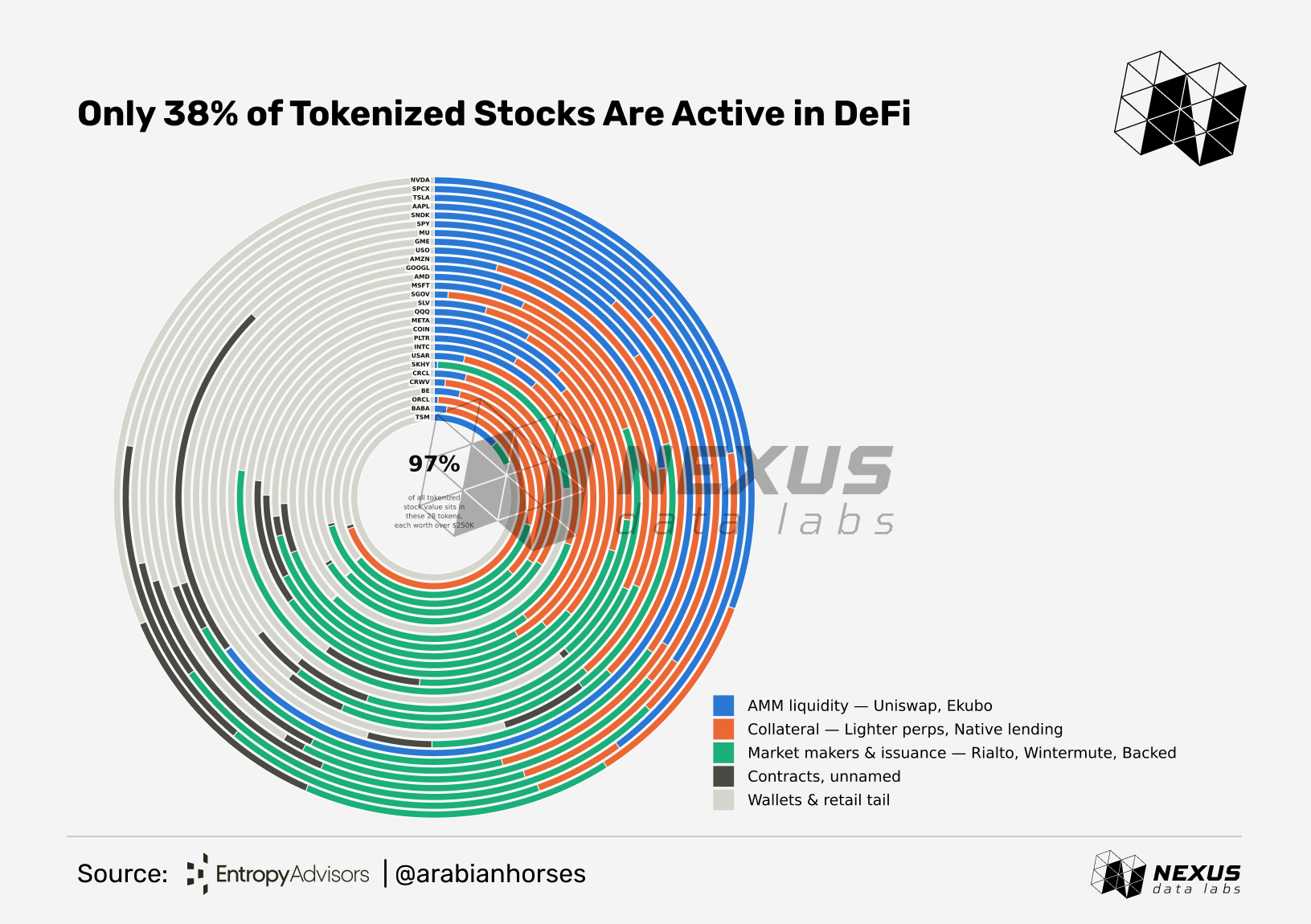
The chart breaks down where each of the top 28 tokenized stocks sits, from DEX liquidity and lending collateral to market-maker inventory and idle wallets. On the first count, 38% of tokenized equity value is used in DeFi as liquidity or collateral, while a single market-making desk accounts for 18%. The rest remains in wallets.
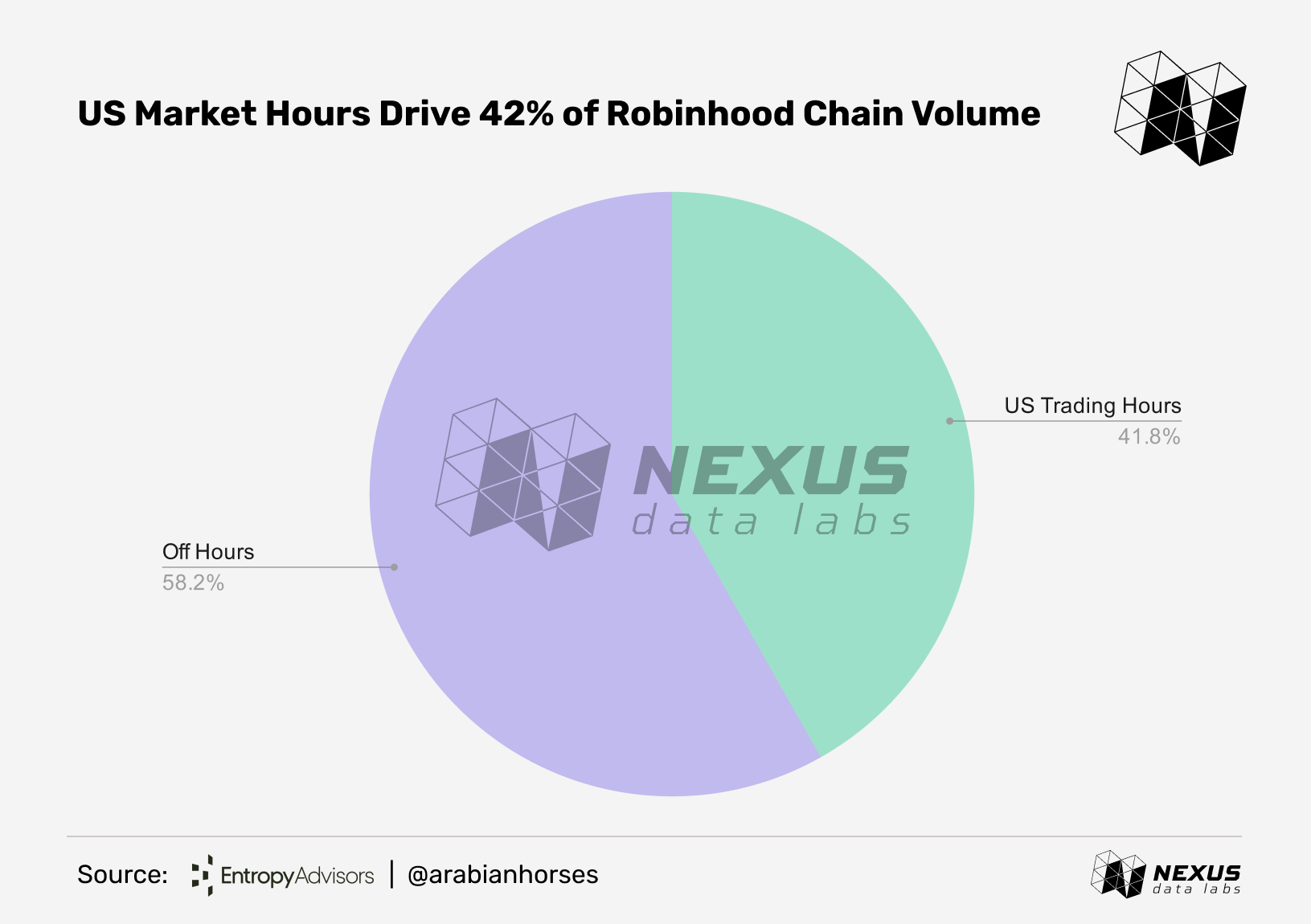
On the second, the 6.5-hour U.S. trading session represents only 19% of the week, yet it still accounts for 42% of all trading volume. Weekend activity is lower, with a typical weekend day generating roughly one third of the volume seen on a weekday. The chain may operate around the clock, but most activity still follows the traditional market calendar. Off-hours volume exists, and it is measurable, but 24/7 access has not yet changed how these assets trade.
Closing Thoughts
Robinhood Chain has had one of the fastest starts of any L2 this cycle. On growth, the launch has worked.
The more important question is what that growth represents. Speculative trading dominates activity, while tokenized stocks, the chain's headline use case, remain mostly inactive. Most of that value is held in wallets rather than deployed in DeFi. The infrastructure for equity-backed credit exists. Usage has not followed.
The next few months will show whether this is early activity chasing incentives or the beginning of a financial institution's retail distribution moving onchain. Robinhood is one of the few institutions launching an L2 with an established retail audience, much like Coinbase with Base.
Distribution alone is not enough. The real test is whether Robinhood can turn tokenized equities from assets people hold into assets people use. Otherwise, Robinhood Chain risks becoming a Robinhood-branded venue for the same speculative activity already taking place elsewhere.
What We're Watching
Web3 Data Jobs
Nexus is partnering with Unchain Data to highlight opportunities across the onchain data ecosystem. This week’s featured openings:
