

Intro
Welcome to the seventeenth edition of Nexus Data Labs, where we highlight what matters most in the fast-developing world of onchain finance.
Thank you to Diego, Rafi, and J.W. for their contributions to this issue.
Setting the Scene
As covered last week, USDT and USDC account for roughly 87% of the $297B stablecoin market. Beneath that dollar duopoly sits a much smaller, faster-moving segment: stablecoins pegged to currencies other than the dollar.
Non-USD stablecoin supply totals $1.55B, representing less than 1% of the market. But headline size understates the opportunity. While dollar-backed stablecoins compete primarily on liquidity and distribution, this segment is shaped by geography, with each stablecoin tied to a specific currency, regulatory environment, and a user base the dollar does not directly serve.
That dynamic is what makes the category worth watching. It is small enough to move quickly and fragmented enough that the leaderboard is still being written. This week's edition breaks down the landscape and explores why non-USD stablecoins could play a meaningful role in the next phase of onchain finance.
Sector Overview
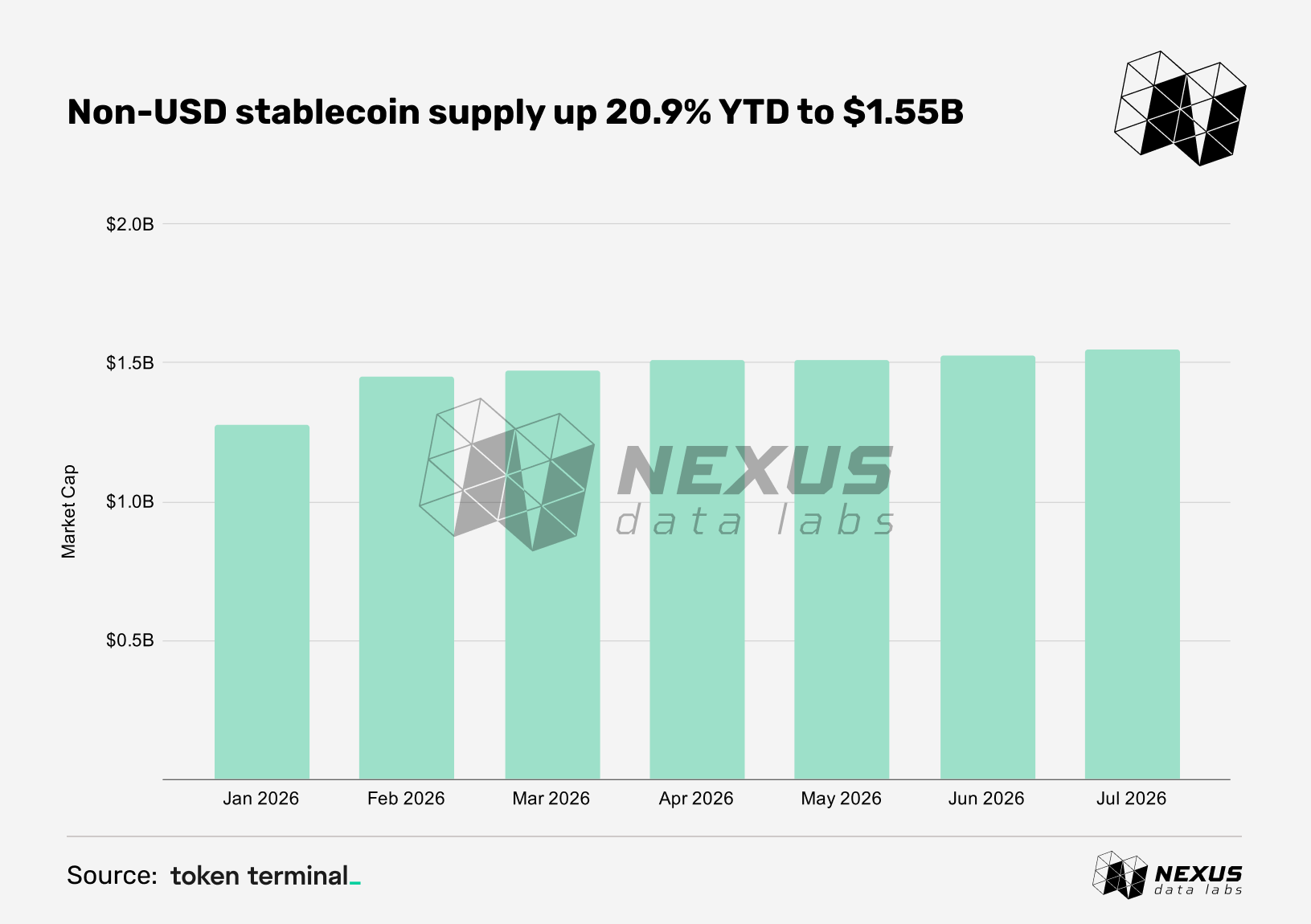
Non-USD stablecoin supply grew 20.9% YTD to $1.55B, with Euro and Real assets holding 90% of the market
Total non-USD stablecoin supply reached $1.55B in July 2026, up from $1.28B at the start of the year, a 20.9% increase. Euro-pegged and Brazilian real-pegged stablecoins together account for nearly 90% of the market. That dominance is slowly declining. EUR and BRL grew by $81M and $109M to $771M and $615M respectively, but their combined market share declined from 93.5% to 89.7% as smaller currencies gained ground faster.
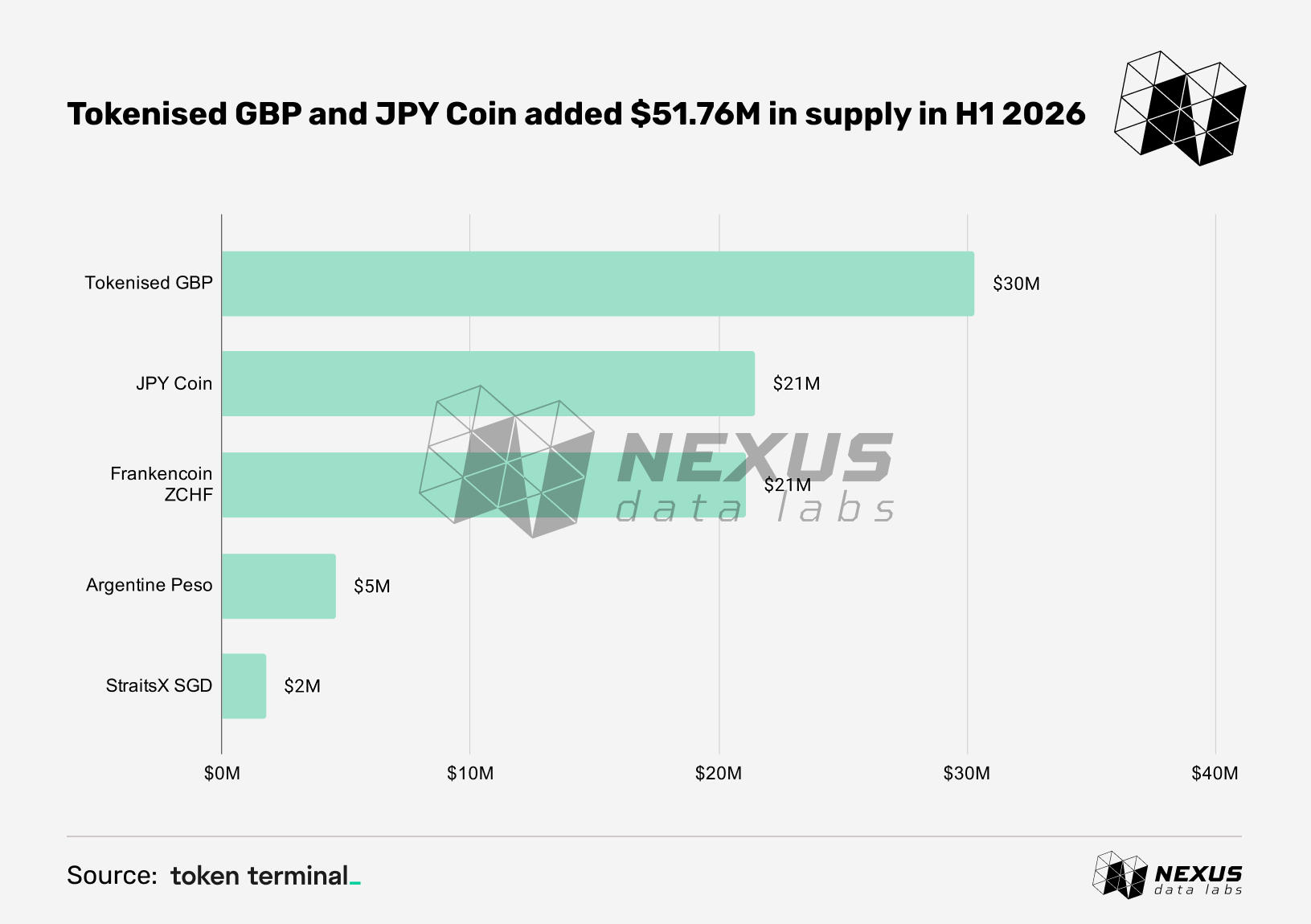
The strongest gains in H1 2026 came from a more diversified set of assets:
Tokenised GBP: $35.61M (+$30.31M)
JPY Coin: $37.83M (+$21.45M)
Frankencoin ZCHF: $43.73M (+$21.09M)
Argentine Peso: $4.84M (+$4.56M)
StraitsX SGD: $17.43M (+$1.75M)
Local Stablecoin on Base
Local Stablecoin on Base reached $156M in 2026 Q2, marking 24.8% QoQ growth
Local stablecoin market cap on Base reached $156M in Q2 2026, up 24.8% QoQ and 3.1x YoY. The ecosystem now spans 32 projects across 21 native currencies, more than doubling from 15 projects in Q2 2024. The geographic footprint has widened just as fast. What was previously concentrated across Africa, Europe, and North America has broadened to include Latin America, Southeast Asia, and Oceania. Local stablecoins on Base are looking less like isolated regional experiments and more like a global layer of onchain finance.
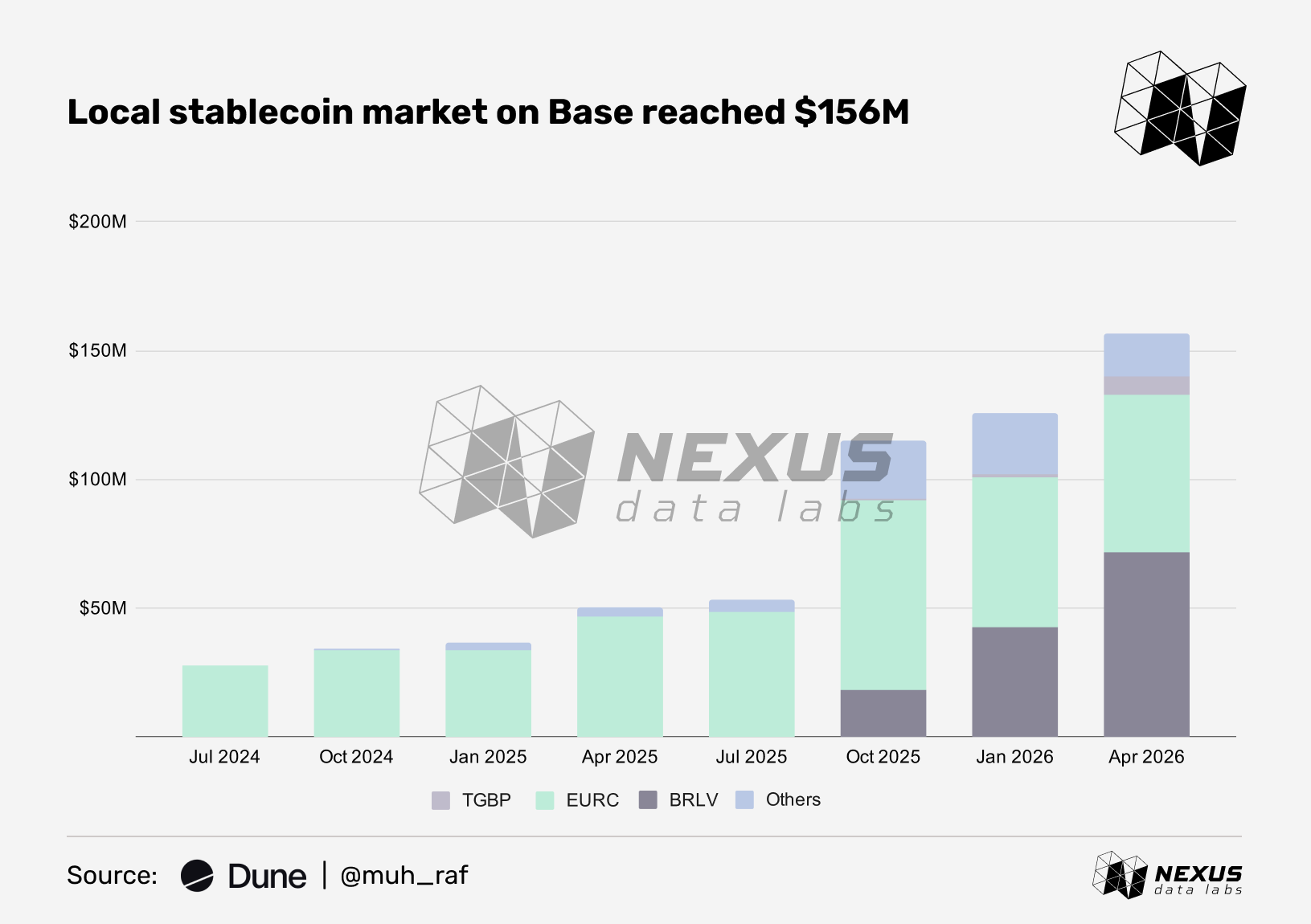
Market structure remains concentrated. BRLV, the Brazilian real stablecoin, is now the largest local stablecoin on Base at $73M market cap, approximately 45% of the market. EURC follows at $61M (39%), with TGBP, the British pound stablecoin, rounding out the top three near $7M (4%). TGBP was the quarter's standout, climbing from $1.24M in Q1 to $7M in Q2 2026, a 465% QoQ increase. Small in absolute terms, but the jump signals the potential for local stablecoins to gain traction as demand for non-USD assets continues to develop.
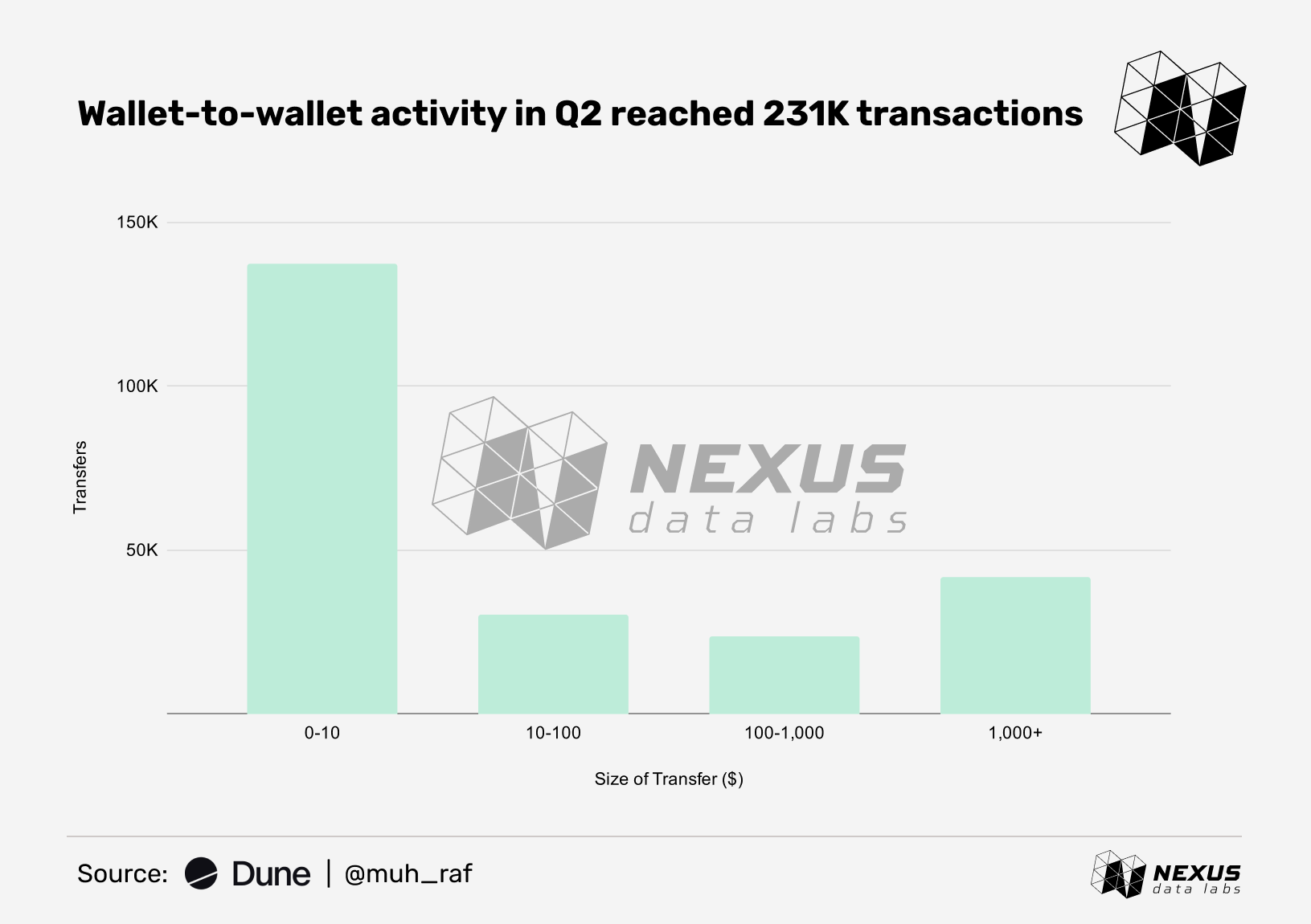
Wallet-to-wallet (EOA-to-EOA) activity totaled 231K transactions in Q2 2026:
$0–$10 (micro): 137K
$10–$100 (small): 30K
$100–$1,000 (medium): 23K
$1,000+ (large): 41K
Micro-transactions dominate, suggesting a real base of frequent, low-value transfers between individual wallets, but 41K transactions above $1,000 indicate a broader range of onchain use cases beyond everyday payments. EURC appears across every size bucket, consistent with its status as the most widely adopted regulated asset rather than a niche instrument. IDRX, the Indonesian rupiah stablecoin, ranks second across the micro, small, and medium tiers, a sign of growing peer-to-peer adoption in its local market.
Total transaction count reached a record 5M in Q2 2026, up 16.3% QoQ from 4.3M and 100% YoY from 2.5M in Q2 2025. EURC accounted for the majority with 4.8M transactions, followed by XSGD, the Singapore dollar stablecoin, at 179K and CADC, the Canadian dollar stablecoin, at 100K. Transaction growth tracking alongside market cap expansion suggests adoption driven by real usage. EURC’s dominance shows the regulated, established players still carry the bulk of activity, but the rise of XSGD and CADC points to real, if early, demand beyond the dollar.
EURC by Circle
EURC crosses $500M market cap, backed by Circle's distribution and regulatory positioning
EURC has surpassed $500M in market cap, reflecting accelerating demand for regulated, euro-denominated liquidity onchain. Supply has doubled year-over-year, supported by Circle’s distribution network and regulatory positioning, reinforcing EURC’s lead among euro stablecoins.
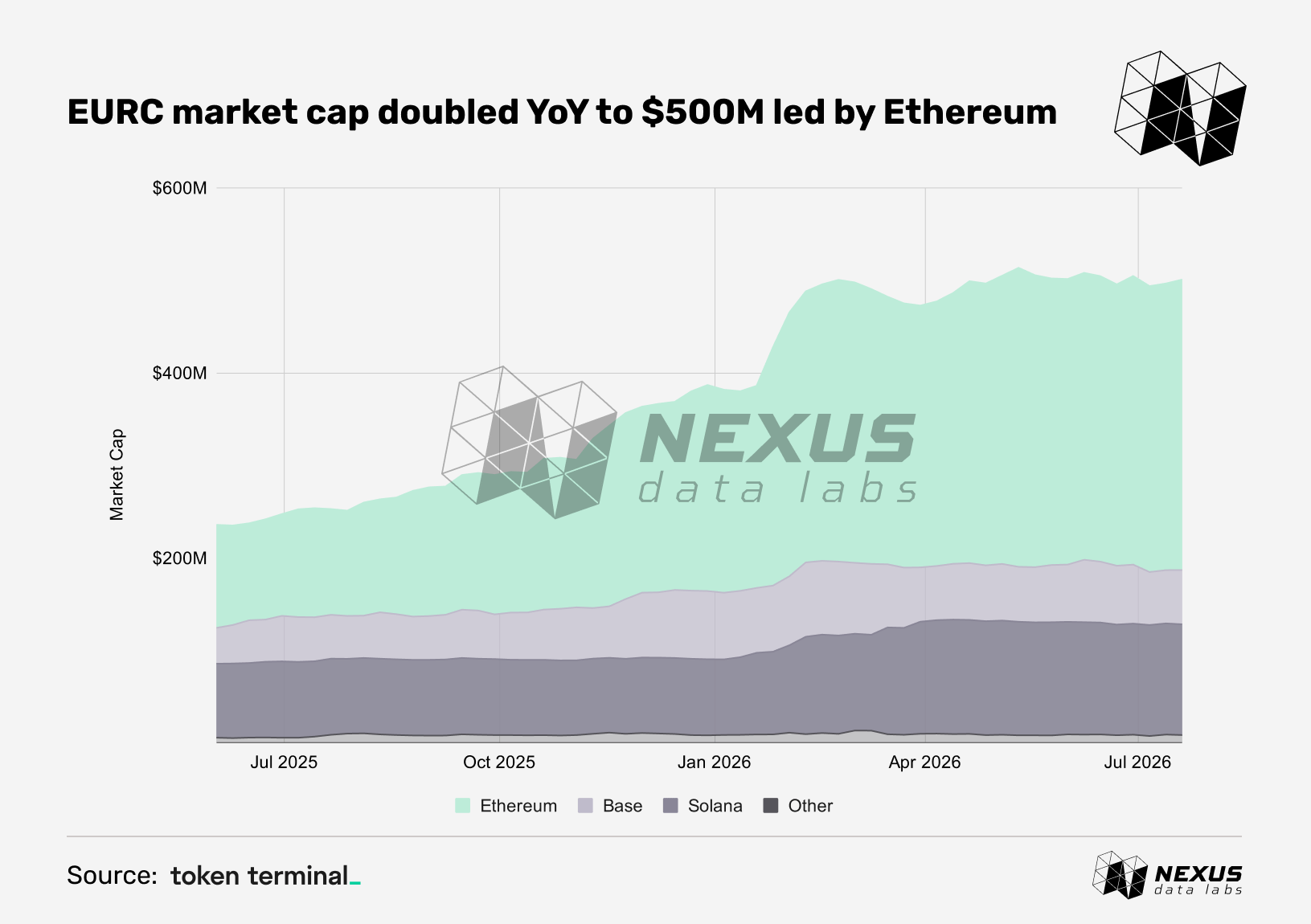
Supply remains concentrated on Ethereum, which accounts for 62% ($312M), while Solana and Base represent 24% and 12%, respectively. Ethereum continues to anchor liquidity, benefiting from its deep DeFi markets and established institutional infrastructure.
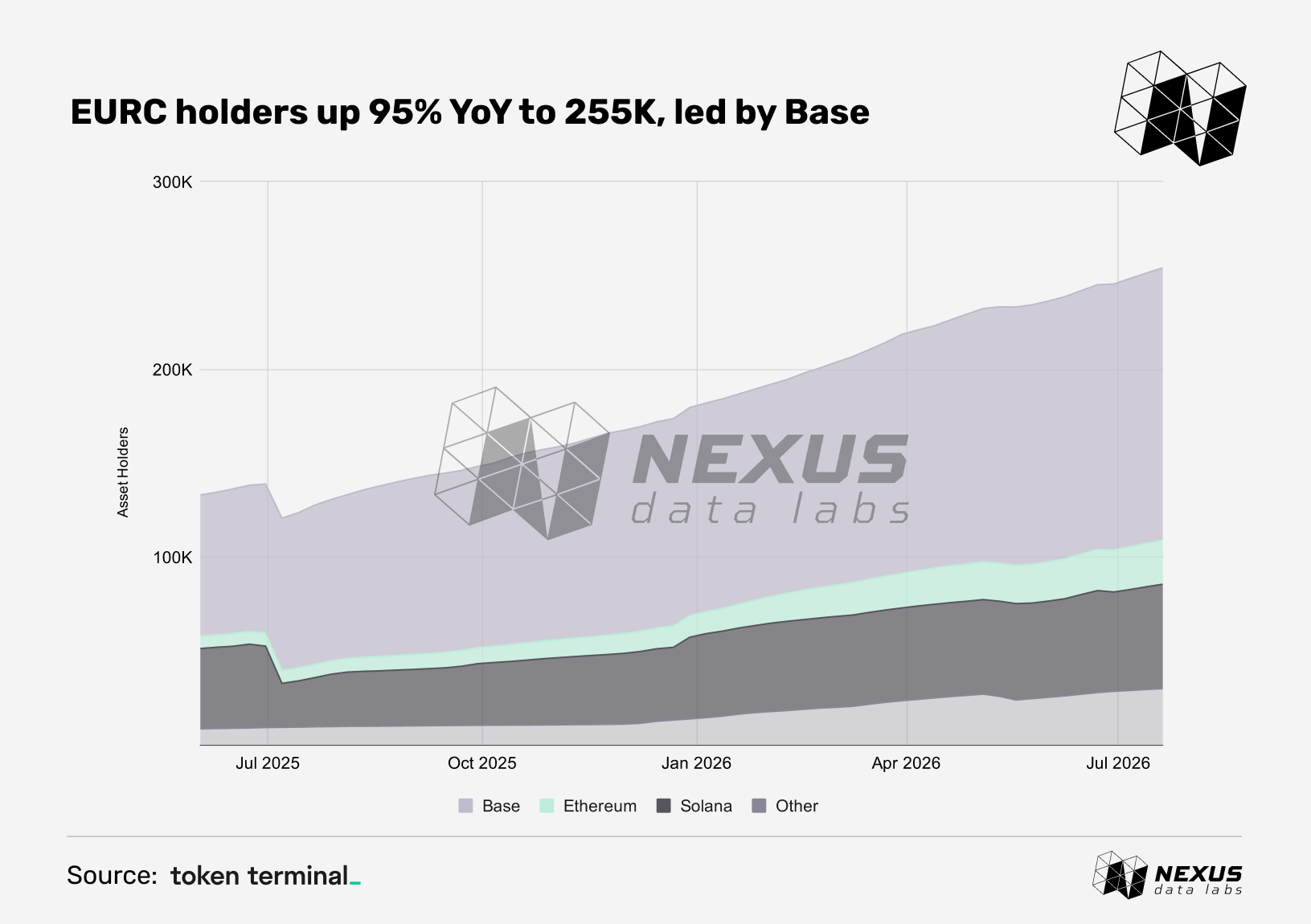
While liquidity concentrates on Ethereum, user adoption and transactions are shifting to Base, driven by Coinbase's L2 ecosystem and its integration into consumer and payments flows. Liquidity lives on Ethereum, but the users are on Base.
Closing Thoughts
Non-USD stablecoins remain a small share of the market today, but not everything settles in dollars. This segment reflects the next phase of stablecoin adoption.
The constraints are clear. USD stablecoins benefit from deep liquidity, established distribution, and years of default usage, and matching that in local currencies will take time. Yet most of the world earns, spends, and operates in local currencies, where reliance on dollars introduces both friction and FX risk.
Non-USD stablecoins are not direct competitors to USDT or USDC. Instead, they address a segment of the global monetary stack that dollar stablecoins do not naturally serve. While still early, their role is increasingly essential as the onchain economy expands beyond its dollar-based foundation.
What We're Watching
Web3 Data Jobs
Nexus is partnering with Unchain Data to highlight opportunities across the onchain data ecosystem. This week’s featured openings:
